Severn Valley Railway Timeline 1970

This page provides a timeline of events on the Severn Valley Railway during 1970, the year in which the SVR in preservation began operating passenger services between Bridgnorth and Hampton Loade.
January 1970[edit | edit source]
Passenger services between Bewdley and Kidderminster, and Bewdley and Hartlebury, were withdrawn by BR with effect from 5 January 1970. The last service was the 19:20 DMU from Bewdley to Kidderminster on Saturday 3 January 1970. This resulted in Bewdley Station becoming disused, along with the lines from Bewdley to Stourport and Foley Park. The original Severn Valley Railway remained open for coal traffic between Hartlebury and Stourport Power Station, while a section of “The Loop” remained open between Kidderminster Junction and the British Sugar Corporation factory at Foley Park.
Following the Minister of Transport's favourable desision in December 1969, the Light Railway Order (LRO) allowing BR to work the line from Bridgnorth to Alveley as a Light Railway was published on 5 January. Richard Dunn applied for the subsequent Transfer Order which, provided no objections were received by 28 February and the line was passed by the Inspecting Officer from the Ministry of Transport, meant the line could re-open.[1][note 1]
The ground floor sections of the former Pensnett signal box were brought from Pensnett to Hampton Loade for use in rebuilding the signal box there.[2]
February 1970[edit | edit source]
The Civil Engineering Department welded more than a ton of steel plates onto the bridge girders of Hay Bridge to strengthen it.[2]
On 23 February the SVR entered into an Agreement with Salop County Council that the Company would dedicate the necessary land to build Bridgnorth Bypass, which would sever the line south of Bridgnorth. The SVR would then be responsible for construction of a bridge over the bypass. This agreement was necessary before the LRO could be granted to reopen the line.[3]
March 1970[edit | edit source]
Ministry of Transport Railway Inspector Maj. Olver visited the SVR on 14 March and made certain recommendations concerning how the Railway should be operated if public services began. An Easter Steam gala was held at the end of March, attended by around 5,000 people. Train rides could still not be provided as the LRO had been delayed by objections from Chelmarsh Parish Council and an individual, but footplate rides were given within Bridgnorth station limits using 3205, 46443, 8233, 2047 and 686.[4][5]
April 1970[edit | edit source]
The SVR met with BR on 7 April and agreed the final price for the purchase of the southern section of the line between Alveley Sidings and Foley Park. A letter of intent was sent to BR the following day.[6]
Around this time, SVR News announced that the SVR and the Worcester Locomotive Society had failed to agree the terms on which the latter's two locomotives 5786 and Carnarvon would remain on the SVR. The dispute centred around the requirement that only paid up members of the Severn Valley Railway Company could work on or operate locomotives on the railway as required by the SVR's insurers and the Inspecting Officer of Railways.[7]
-
 Carnarvon at Bridgnorth in 1970 (David Cooke)

May 1970[edit | edit source]
Following the inspection visit in March, the second Light Railway Order was granted on 20 May 1970, allowing the SVR to begin running public services between Bridgnorth and Hampton Loade.
Whit weekend, Saturday 23 May 1970 saw the official opening of the Severn Valley Railway in preservation, with the first public trains running between Bridgnorth and Hampton Loade. Loco 3205 hauled the first service, the 14:00 from Bridgnorth. 46443, 43106, 48773 and Railcar 22 were also used over that weekend. The following weekend saw trains begin to run a regular weekend service.
-
 3205 at Bridgnorth, opening day 1970 (Wikimedia Commons)
 -
 43106 at Bridgnorth, opening day 1970 (Wikimedia Commons)
 -
 Opening day, 1970 (Wikimedia Commons)
 -
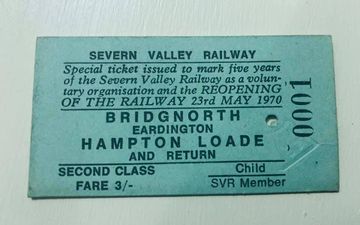 Child ticket 0001 from the opening day
 -
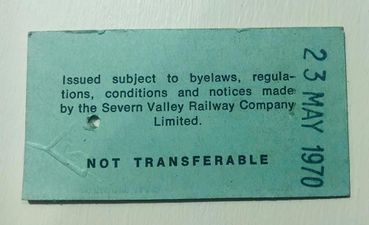 Child ticket 0001 from the opening day


June 1970[edit | edit source]
3 weeks after opening a potential problem emerged. Although the LRO gave the Guarantee Company a ‘license’ to operate, the line itself was still owned by BR and therefore subject to the BR steam ban. Services therefore ceased, but within 2 weeks SVR members and well-wishers from around the world had boosted the ‘line fund’ to the extent that the balance of the £25,000 purchase price could be paid to BR. Services then re-commenced, with the line now owned by the SVR itself.
July 1970[edit | edit source]
By 12 July the 10,000th passenger had already made the return journey to Hampton Loade, the final figure at December would be more than 63,000.
On 19 July Sir Gerald Nabarro, the Conservative MP for South Worcestershire, visited the SVR and rode on 3205. He also met with SVR Solicitor Richard Dunn.[8]
-
 Richard Dunn with Sir Gerald Nabarro
G.C. Lees / SVR News)

August 1970[edit | edit source]
The SVR's first motor bus, Leyland Titan KPT 909, arrived on 19 August.
-
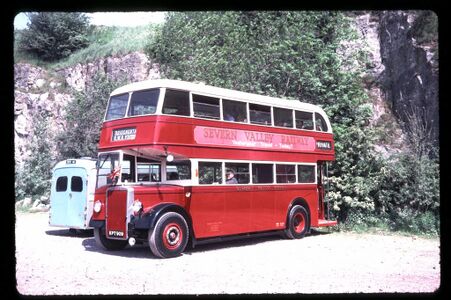 KPT 909 at Crich in 1977 (© Hats Pics)

LMS Stanier 5MT 45110 arrived by rail on 20 August. The locomotive was hauled by a Type 2 diesel from Bescot to Bewdley in light steam, and then moved to Bridgnorth under its own power. After minor work was carried out, it entered passenger service a few weeks later.[9]
GWR Churchward 4500 'Small Prairie' No 4566 arrived by rail on 25 August. It was only the eighth locomotive to leave Barry Scrapyard and the first destined for the SVR.
September 1970[edit | edit source]
On 3 September the water tank from Henley in Arden was moved to its new location on the hill behind Bridgnorth station.[10]
The Stanier 8F Locomotive Society was incorporated on 29 September.[11]
Hollybush Road Footbridge was closed by Bridgnorth council on 30 September.
October 1970[edit | edit source]
Following the closure of Bewdley Station, the SVR advised BR's Estates Department that it was not interested in acquiring any of the line from Bewdley to Stourport, which was affected by a number of road schemes. However the SVR would be interested in acquiring the line from Milepost 144½ at Alveley to Bewdley and Foley Park, in order to maintain their main line access. BR advised the SVR that Salop and Worcester County Councils, who legally had first refusal, did not wish to acquire the railway land. On Thursday 15 October the SVR's representatives met with BR's Estates Department to agree a price for the purchase of the southern section of the line from the current boundary at Alveley to Foley Park. A figure of £74,000 was provisionally agreed.[12]
On Friday 23 October the SVR Directors held an informal meeting at Kidderminster Town Hall with around 300 SVR members present. The meeting discussed the proposals for extending the line to Foley Park, including the benefits (mainly retaining the connection to BR), the proposed cost, and how this could be funded. Two principal options were outlined by the Chairman Andrew Marsden-Smedley, either to float a commercial company with the accent on achieving profitability for shareholders, or to convert the scheme to a Trust Corporation, enabling the SVR would be able to accept grants from the government and local authorities. The meeting agreed with his opinion that the latter option was preferable. The Directors also re-affirmed their commitment to retaining the Bridgnorth site by funding and building a by-pass bridge should this ever become necessary. The SVR members agreed in principle that, even though the cost was significantly more than the Society had previously raised to date, the extension to Foley Park was desirable. The Chairman confirmed that he would take matters further.[13]
The winter timetable began on Saturday 31 October.[note 2] For the rest of the year, Saturdays comprised two round trips between Bridgnorth and Hampton Loade in the morning and early afternoon by the Diesel Railcar. Sundays saw two afternoon round trips with one steam locomotive.[14]
-
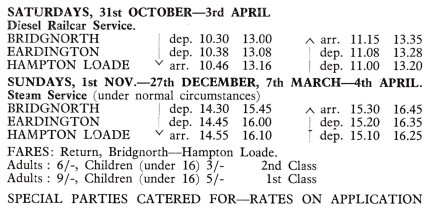 Winter timetable 1970-71 (SVR News)

November 1970[edit | edit source]
Sir Gerald Nabarro was appointed as an additional Director of the Guarantee Company on 1 November.[15]
After a 3-stage journey from Coventry Colliery, BR(W) Hawksworth 1500 class 0-6-0PT 1501 officially arrived on the SVR on 7 November after being hauled from Bewdley to Bridgnorth by 43106.[note 3][16]
Steam locomotives used[edit | edit source]
A table of steam locomotives used and their mileages can be found on the Steam Locomotive Mileages page.
See also[edit | edit source]
| ||||||||||||||||||||||||||||||||||
Notes[edit | edit source]
- ↑ The planned opening date at the time was Easter; in the event it was May.
- ↑ With no prior experience of winter working, the timetable was only agreed at a meeting for Department heads shortly before that date.
- ↑ 1501 was towed from Coventry to Tyseley on 17 July for tyre turning, then to Kidderminster and Bewdley on 17 October. During the latter move it ran hot on one axlebox due to excess speed, delaying the final move on to the SVR's metals.
References[edit | edit source]
- ↑ SVR News 15, p. 3.
- ↑ 2.0 2.1 SVR News 16, pp. 18-19.
- ↑ SVR News 19, p. 4.
- ↑ Magner (1997) p. 55.
- ↑ Marshall (1989) p. 172.
- ↑ SVR News 17, pp. 8-9.
- ↑ SVR News 17, p. 9.
- ↑ SVR News 17, p. 8.
- ↑ SVR News 18, pp. 10-11.
- ↑ SVR News 18, p. 8,.
- ↑ Companies House
- ↑ SVR News 18, p. 3.
- ↑ SVR News 18, pp. 4-5.
- ↑ SVR News 18, p. 28.
- ↑ Marshall (1989) p. 174.
- ↑ SVR News 19, p. 7.