Severn Valley Railway Timeline 1971

This page provides a timeline of events on the Severn Valley Railway during 1971. The first full year of SVR operation saw Sir Gerald Nabarro assume control of the Railway.
January 1971[edit | edit source]
During Janary and February the Civil Engineering Department carried out work to strengthen the Underbridge at Hampton Loade. As a result the Sunday timetable was discontinued; the Saturday Diesel Railcar 'shoppers' service remained but terminated around 50 yards short of Hampton Loade with passengers accessing the station via a temporary walkway.[1]
-
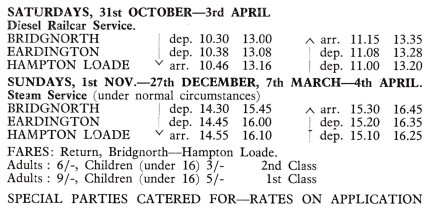 Winter timetable 1970-71 (SVR News)

February 1971[edit | edit source]
On 16 February a total price of £74,000 was finally agreed, subject to contract, for the southern section of the line between Alveley Sidings and Foley Park the new boundary with BR being at a point 200 yards east of Foley Park Halt. The SVR Directors proposed to float a new Company with a share capital to fund the purchase, to provide adequate working capital to work the whole line, and to employ some essential staff. The existing Guarantee Company would continue to operate the Railway. The proposals would be presented at the AGM on 1 May.[2]
March 1971[edit | edit source]
LMS Ivatt Mogul 2MT No 46521 arrived by rail from Barry Scrapyard on 20 March. It was delivered to Bewdley by a BR Type 4 diesel, and collected by 45110 with goods rolling stock providing separation for crossing Victoria Bridge. 46521 would later become the first ex-Barry restoration to enter service on the SVR in 1974.
-
 Bridgnorth in March 1971 (Wikimedia Commons)

April 1971[edit | edit source]
On Saturday 3 April, the "Warwickshire Industrial Steam Gala" took place, jointly organised by the SVR and the WILPG. 2047 Warwickshire was officially named by representatives of former owners Rugby Portland Cement and then operated a brake van trip to Hampton Loade. 686 The Lady Armaghdale also made a brake van trip to Hampton Loade later in the day.[3] On the same day7, two Wickham trolleys, PWM2827 (B190W) and PWM3774 (B13W), arrived on the SVR from Worcester.
BR Standard 7MT No 70000 Britannia arrived on 9 April, and was delivered to Bridgnorth by 43106.[4]
-
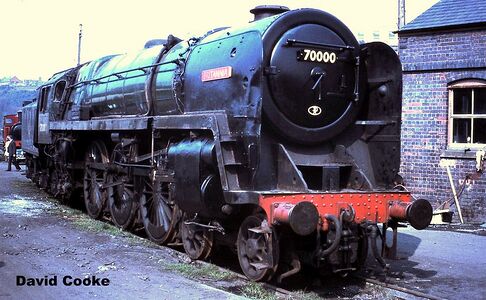 70000 Britannia shortly after arrival (David Cooke)

On 10 April the SVR's first Diesel, Highflyer arrived. A summer timetable began on the same day between Bridgnorth and Hampton Loade, running at weekends and bank holidays until 31 October, with an hourly service on the busiest days operated by either one or two steam locos plus Railcar 22.
-
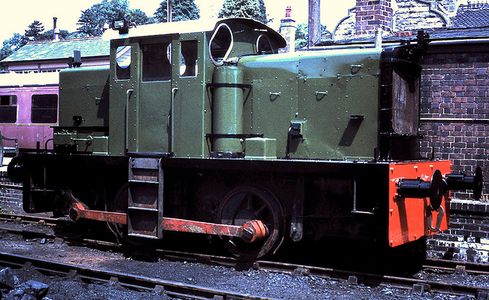 No. 17 Highflyer (David Cooke)

May 1971[edit | edit source]
At the Guarantee Company AGM on 1 May 1971 Sir Gerald Nabarro outlined his proposals for raising the money to purchase of the southern portion of the line from Alveley to Foley Park. He dismissed the idea of forming a Trust Corporation (which had been the recommendation of the informal meeing in October 1970), and proposed instead to form the Severn Valley Railway (Holdings) public company. This would have a capital of £150,000 raised by a public share issue. The meeting was then adjourned until 6 August.
-
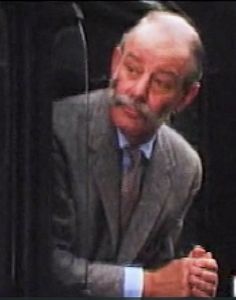 Sir Gerald Nabarro on the footplate of 45110 at Bridgnorth in 1971

BR Standard 4MT 2-6-4T No 80079 arrived from Barry Scrapyard on 15 May.
June 1971[edit | edit source]
GWR Collett 5700 0-6-0PT No 5764, ex-London Transport L95, arrived on 19 June.[5] It was steamed four hours later.[6]
-
 Arrival of 5764 (David Cooke)

July 1971[edit | edit source]
Following Sir Gerald Nabarro's presentation to the adjourned AGM in May, SVR Chairman Andrew Marsden-Smedley wrote a personal letter to the SVR membership on 2 July. The letter called for all members to support a resolution altering the structure of the Railway Company to enable money to be raised by the issue of shares to enable the southern section of the line, from Alveley to Foley Park, to be purchased, and also to provide finance for the provision of the Bridgnorth by-pass bridge, should it be needed. He considered that it would be necessary for the Guarantee Company to be wound up, with £40,000 of Holdings Company shares being vested in a Members' Association, the Severn Valley Railway Association, in exchange for the assets it formerly held in the northern section.[note 1] The remaining £110,000 would be new money raised by the share issue. He also agreed to retire as Chairman and be replaced by Sir Gerald Nabarro.[7]
Also on 2 July, a meeting of former committee members of the Severn Valley Railway Society took place. Concerned by these developments, they discussed forming a Severn Valley Railway Association to protect the interests of the members. A meeting of members at Bridgnorth on 17 July agrred to this proposal and elected a provisional committee.[8]
August 1971[edit | edit source]
On 6 August the Guarantee Company AGM reconvened to discuss Nabarro's plans for restructuring the railway, and Andrew Marsden-Smedley's recommendations. After lengthy discussion the members agreed that the Board of Directors should take whatever steps were considered practicable to (a) purchase the Southern Section of the line and (b) secure the Northern Section, having regard to the estimated cost of building a by-pass bridge amounting to not less than (say) £60,000 at1970 prices.[9]
Ex-MOD Hunslet WD Austerity 0-6-0ST WD 193 arrived on 7 August. On the same day The Lord Bishop of Wakefield, the Rt. Rev. Eric Treacy, visited Bridgnorth and travelled on the footplate of 46443 to Hampton Loade. 'The Railway Bishop' promptly became a life member of the SVR.[10]
A double album LP entitled Severn Valley Railway: Sound & Songs, produced by John Baxter and Peter Lingwood for the Severn Valley Railway, was released on 28 August.[11]. A copy is held in the national collection.[12]
September 1971[edit | edit source]
Sir Gerald Nabarro was duly appointed Chairman at the next Directors' meeting on 7 September. Andrew Marsden-Smedley retired as a Director.[13]
45110 received the name R.A.F. Biggin Hill in a ceremony at Bridgnorth on 12 September.[14] The name was never popular among the volunteers, with notices appearing stating that the prctice of removing the nameplates must cease.[13]
Ex Longmoor Military Railway WD Austerity 2-10-0 No 600 Gordon and three ex-Longmoor Military Railway saloons arrived on 20 September on loan from The Transport Trust.[15]
October 1971[edit | edit source]
The Severn Valley Railway Association was formally constituted at its first meeting on 16 October. Its principal objects were to safeguard the interests of the members of the Guarantee Company and to promote the efficient organisation, financial standing and growth of the Severn Valley Railway. John Garth was nominated as Chairman.[16]
November 1971[edit | edit source]
The BR Board signed a provisional contract on 5 November agreeing to sell the land occupied by the southern section of the line for £25,000, with a deposit of £5,000 paid by the SVR Company (a separate contract of £49,000 for the track, buldings and engineerng works was signed in January 1972 with a further deposit of £5,000.).[13]
Steam locomotives used[edit | edit source]
A table of steam locomotives used and their mileages can be found on the Steam Locomotive Mileages page.
See also[edit | edit source]
| ||||||||||||||||||||||||||||||||||
Notes[edit | edit source]
- ↑ In late 1971 it transpired that it was not possible to transfer the Light Railway Order from the Guarantee Company to another company, hence that company would need to remain in existence. As a result, the Association did not receive the 40,000 shares.
References[edit | edit source]
- ↑ SVR News 18, p. 28.
- ↑ SVR News 19, Matters of Moment, Richard Dunn
- ↑ SVR News 19, p. 30.
- ↑ SVR News 19, p. 8.
- ↑ SVR Stock Book Ninth Edition
- ↑ SVR News 20, p. 16. (picture dated 20 June)
- ↑ Marshall (1989) p. 174.
- ↑ Marshall (1989) p. 175.
- ↑ SVR News 22, pp. 4-6.
- ↑ SVR News 22
- ↑ SVR News 20, p. 5.
- ↑ Science Museum Group, object description (Retrieved 22 September 2004)
- ↑ 13.0 13.1 13.2 Marshall (1989) pp. 176-7.
- ↑ SVR News 21, pp. 7-9.
- ↑ SVR News 21, pp. 10-11, 24-26.
- ↑ SVR News 21, pp. 4-6.