Severn Valley Railway Timeline 1967

(Sellick Collection)
This page provides a timeline of events on the Severn Valley Railway during 1967. The year saw the arrival of the Railway's first locomotives and rolling stock.
-
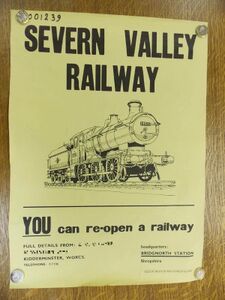 Recruitment poster to help reopen the railway

February 1967[edit | edit source]
The Severn Valley Railway Society paid the balance of the 10% deposit of £2,500 to BR on 8 February 1967[1]. (the balance of the full purchase price was paid shortly after the official opening in May 1970). Once the deposit had been paid, BR allowed rolling stock to be moved in.
In early February six SVR volunteeers travelled to Buckfastleigh in Devon to prepare GWR 0-6-0 No 3205 for a move to the SVR, which required the motion to be removed and the axle boxes to be oiled among other tasks.[2] On Wednesday 22 February BR 'Warship' D855 Triumph hauled 3205 and two 'Glyncorrig' coaches GWR 3755/6 to Bristol, where 3205 was turned and a third coach GWR 6562 collected. The convoy then travelled to BR shed at Stourbridge Junction.[3] A fourth coach W7285 was delivered to Stourbridge around a week later. Once at Stourbridge, the SVR volunteers began re-assembling 3205 and preparing it for a move to the SVR in steam. John Hill (SVR driver and BR Tyseley professional railwayman) was instrumental in the preparation process, as well as acting as chief negotiator at Rail House, Birmingham, in connection with 3205's movement to Bridgnorth.
March 1967[edit | edit source]
3205's boiler passed an inspection by BR on Saturday 11 March. On Easter Saturday 25 March[note 1] 3205 and 4 GWR coaches arrived at Bridgnorth, having made the journey in steam from Stourbridge Shed. The footplate crew were BR driver Cyril Williams (Stourbridge MPD) and SVR driver John Hill (BR Tyseley) with Gerry Carter firing the entire journey.[4] Although it was not officially a "steam weekend", the arrival saw several thousand visitors over the three days, with 3205 and two coaches giving rides as far as Oldbury Viaduct. The event featured on ITV's 'Midlands Today, giving the railway a publicity boost.[5]
-
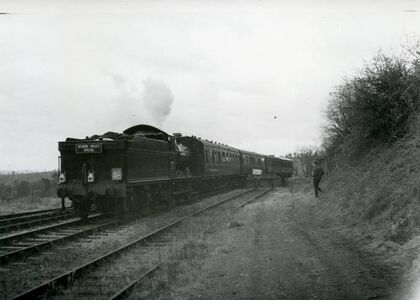 The first locomotive to arrive, ex-GWR 3205, approaches Bridgnorth on 25 March 1967 (Sellick Collection)
 -
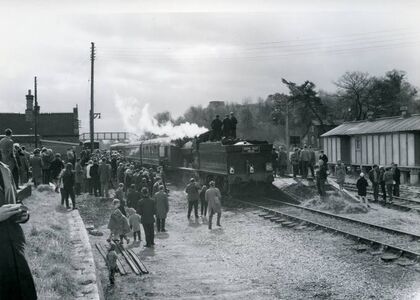 A large crowd greets 3205 on arrival Bridgnorth on 25 March 1967 (Sellick Collection)


April 1967[edit | edit source]
On 22 April, Richard Willcox's Ivatt 2MT No 46443 became the second locomotive to arrive on the SVR. BR gave permission for the move from Newton Heath (Manchester) to Bridgnorth via Crewe, Stafford, Bescot, Dudley, Stourbridge and Kidderminster to be made in steam.[6]
May 1967[edit | edit source]
A small 'open day' took place on 6-7 May. Ivatt 46443 was steamed although no rides were given.
GWR Railcar 22 was moved from storage at Swindon to Gloucester on 3 May in a parcels train, and then to Kidderminster on 5 May in a freight. On Friday 12 May it was moved to the SVR boundary in an Alveley Colliery empties train, and collected by 3205 on 13th May.[7]
During 1966 the Society had ascertained that a new Company would need to be formed to apply for a Light Railway Order (LRO) to transfer responsibility for the line; the Society itself not being able to apply for legal reasons. Severn Valley Railway Company Limited, the 'Guarantee Company' (being a Private Company Limited by Guarantee), was incorporated on 24 May 1967 in order to make the application for the LRO at the appropriate time. However the company remained essentially dormant for the next 2 years, with the Society continuing to conduct the negotiations with BR.
Following a further payment of £2,000, BR granted access to the Bridgnorth goods shed and outbuildings.
June 1967[edit | edit source]
On 1 June,[note 2] exchange of contracts for the purchase of the line between Bridgnorth and Alveley sidings took place between BR and the Severn Valley Railway Company.[8]
On Friday 23 June Railcar 22 moved for the first time under its own power, although only on one engine.[7]
Another 'Open Weekend' took place on 24-25 June. The event featured traction engines, a miniature railway and other attractions as before, although there were no engine movements. Despite poor weather, around 2,000 people attended and £225 of funds were raised.[9]
July 1967[edit | edit source]
At the start of July two new Departments were formed within the 'Working Pary Organisation', Signal and Telecommunications (led by John Denson) and Carriage and Wagon (led by David Carr). Volunteers continued to scout the area for items to be used on the Railway, including a signal frame acquired from Withymoor for use at Bridgnorth and the water tower for use at Eardington (the only source of suitably soft water on the line) respectively.[10]
By July the Society's membership had passed 750. Society members were being encouraged to become members of the newly formed Guarantee Company, with 115 having done so to date.[11]
September 1967[edit | edit source]
BR gave permission for 3205 to travel in steam to Taplow Station goods yard for a GWS open day on 16 September. The return working, which also brought Ocean Liner Saloon 9113 to the SVR, was one of the last steam movements on BR’s Western Region, which was by then fully 'dieselised'[12].
October 1967[edit | edit source]
The first full 'Steam Weekend' took place on 14-15 October. GWR Brake Third 5136 had been installed in the cattle dock at Bridgnorth and was brought into use as a refreshment coach.[13] 3205 and 46443 worked a four coach formation with the last train of the evening being double headed with five coaches. Operations at the time were under the direction of the SVR's newly appointed Traffic Superintendent Mr W Gillett, a Society mamber and also the Chief Operating Inspector of BR's Birmingham Division, and he allowed a full service to Hampton Loade to be run. The Railway had not yet received the Light Railway Order allowing rides to be given to the general public. However SVR members could travel, so the Railway did a brisk trade in 'Day Member' tickets,[note 3] while full membership of the Severn Valley Railway Society also benefited, approaching the 1,000 mark by the end of the year.
-
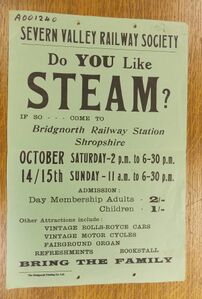 October 1967 Open Day poster

Manning Wardle contractors engine no 2047 (later named Warwickshire) arrived by road at Bridgnorth on 22 October.[14] The 'Railcar Weekend' featured Railcar 22 working hourly services for members between Bridgnorth and Hampton Loade; at the end of the day the Railcar shunted 2047 from the back road into Platform 2.[15]
-
 2047 being loaded at Rugby
 -
 2047 being unloaded at Bridgnorth


November 1967[edit | edit source]
The SVR's fourth steam locomotive, ex-Port Talbot Railway 0-6-0 No 813, arrived on 25 November.
In late 1967 the Civil Engineering Department began construction of a 30ft long locomotive inspection pit at Bridgnorth.[16]
Steam locomotives used[edit | edit source]
A table of steam locomotives used during the 1960s and their mileages can be found on the Steam Locomotive Mileages page.
See also[edit | edit source]
| ||||||||||||||||||||||||||||||||||
Notes[edit | edit source]
- ↑ Clearance from BR for the move was only received on Wednesday 22 March. The proximity to Easter meant a number of SVR members had othe commitments and missed the event.
- ↑ Marshall (1989) p. 168. refers to an exchange of Contracts taking place on 1 January 1968. This pre-dated the formation of the Guarantee Company, although it may have formed the basis on which the Society paid the balance of the depostit in February.
- ↑ The 'day member' ticket provided a return trip to Hampton Loade at a cost of 2/- (10p)
References[edit | edit source]
- ↑ Magner (1997) p. 49.
- ↑ SVR News 5, Working visit to Devon, Gerry Carter
- ↑ SVR News 5, Riding on 3205 "Dead from Bristol East Depot to Stourbridge MPD, David Rouse
- ↑ SVR News 5, Work on 3205 after arrival at Stourbridge and the Journey to Bridgnorth, Gerry Carter
- ↑ SVR News 5, 3205 at Bridgnorth, David Williams
- ↑ SVR News 6, The Journey with 46443 from Manchester to Bridgnorth, Richard Willcox
- ↑ 7.0 7.1 SVR News 6, Work on the Railcar
- ↑ Magner (1997) p. 50.
- ↑ SVR News 6, Open Weekend
- ↑ SVR News 6, Working Party Report
- ↑ SVR News 6, More about the Company
- ↑ Magner p. 50.
- ↑ SVR News 163
- ↑ SVR News 7, Stock Arrivals at Bridgnorth
- ↑ SVR News 7, The Railcar Week-End
- ↑ SVR News 7, The Loco Pit