Severn Valley Railway Timeline 1972

This page provides a timeline of events on the Severn Valley Railway during 1972. During the year the new Holding Company SVR(H) was successfully floated, but the relationship between Sir Gerald Nabarro and the SVR membership deteriorated.
January 1972[edit | edit source]
During a visit to the former Heaton Mersey diesel depot, Frank Cronin noted the shed which would eventually be acquired by the SVR and incorporated into Bridgnorth Loco Works.
On 22 January Arley Ferry closed, being replaced by a footbridge across the River Severn.
On 29 January the BR Board signed the contract to purchase the track, buildings and engineering works on southern section of the line for £49,000 which, together with the contract for £25,000 signed on 5 November 1971 in respect of the land, amounted to the agreed price of £74,000. A second deposit of £5,000 was paid.[1]
March 1972[edit | edit source]
The season began on 4 March, with the timetable closely following that of 1971.
Severn Valley Railway (Holdings) Limited "SVR(H)" was incorporated on 15 March, with Viscount Cobham as President and Sir Gerald Nabarro as Chairman. The role of SVR(H) would be to finance the purchase of the Southern section of the line through the public share issue (for which Nabarro would be the figurehead), and to be responsible for overall policy decisions affecting the whole railway. The Guarantee Company would remain responsible for day to day management and operation of the Railway, including commercial activities, and also be responsible for the membership.[2]
On 16 March an agreement was concluded between SVR(H) and the Guarantee Company that the assets and liabilities of the latter would be transferred to SVR(H) in exchange for 40,000 shares credited as fully paid.[2]
On 18 March Ruston and Hornsby 165hp Diesel Shunter 319290 arrived on the SVR from Langley Green. The locomotive is used as the Bewdley shunter and has also carried the number 'D2957'.
On 19 March the telegraph pole route between Bridgnorth and Hampton Loade was completed with the erection of the final pole near Sterns.[3]
Four days of Easter running began on 31 March, with 6,400 passengers making 13,000 journeys over the 4 days.
April 1972[edit | edit source]
The process for raising the £150,000 share capital for SVR(H) as set out in the Prospectus would be an initial issue of 100,000 shares, followed by a rights issue of £50,000. A public share offer for 58,000 shares was launched on 12 April (2,000 shares had already been issued and 40,000 were alloted to the Guarantee Company in exchange for its assets). For three weeks up to 3 May shares were issued to SVR members only, afterwards they were offered to other members of the public. The share offer closed on 22 May, having been over-subscribed by over £24,000.
May 1972[edit | edit source]
Sunday May 12 saw a notable milestone with Collett 0-6-0 3205 and newly restored 5764 in service together, the first time two GWR locomotives had shared Severn Valley passenger services since the 1960s[4].
June 1972[edit | edit source]
On 10 June the excess proceeds of the share issue were returned to the non-preferential shareholders.[note 1] The SVR announced the rights issue of the further £50,000 at the same time.
On 16 June BR published the application for the LRO for the transfer of the line from Alveley to Foley, Park and Burlish via Bewdley.
On 22 June the Department of the Environment announced the Bridgnorth Bypass had been transferred in to the firm Roads Programme for 1974.
On 24 June Hudswell Clarke Diesel Shunter D577 Mary arrived on the SVR by road from Hindlow.
0-4-0ST Invicta arrived at Bridgnorth on 30 June.
-
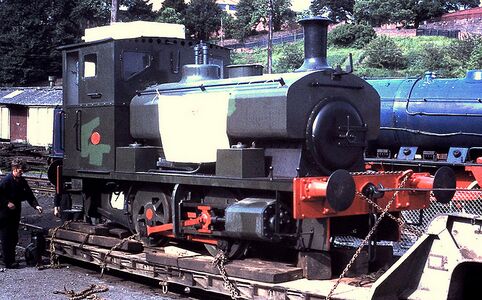 417 Invicta arriving at Bridgnorth

July 1972[edit | edit source]
LMR 600 Gordon Gordon hauled its inaugural passenger train on 29 July.
August 1972[edit | edit source]
Salop County Council formally asked the SVR and other landowners to provide details of land owned by them which would be affected by the Bridgnorth bypass.
September 1972[edit | edit source]
LNER Gresley K4 West Highland 2-6-0 No 3442 The Great Marquess (BR 61994) arrived on 9 September.
The Rights Issue of £50,000 was fully subscribed by the extended closing date of 29 September.
-
 Bridgnorth, September 1972 (Wikimedia Commons)
 -
 Bridgnorth, September 1972 (Wikimedia Commons)
 -
 Bridgnorth, September 1972 (Wikimedia Commons)


October 1972[edit | edit source]
On October 7 the Civil Engineering Department recovered a 2000 gallon water tank from Darlaston for future use at Bewdley. The following day the Department recovered two platform level water columns from Henley-in-Arden for use at Bridgnorth.
November 1972[edit | edit source]
During the year, Nabarro began to assume greater power and control over the Railway (described some years later in an SVR news article as ‘a committee of one’). By November 1972, members and volunteers were openly expressing the view that they were being alienated, and that proposed restructuring of the two Company Boards effectively meant that the membership would have no say in the running of the railway. Suspicions were also growing that the By-pass would be used as an excuse to abandon Bridgnorth and sell the site for housing development.
On 3 November, the Guarantee Company Annual General Meeting was described as 'noisy and controversial' with some 'pungent and straight talking' resulting.[5] Nabarro wanted the extension to Bewdley opened in 1973, against the advice of the Railway's Department Managers that it should be postponed for a year.[note 2] Great dissatisfaction was expressed at the 16 March agreement between SVR(H) and the Guarantee Company, which had resulted in 6 Directors and the Chairman of the Grarantee Company being SVR(H) appointees, and a statement was made that a new contract would be drawn up. The members unanimously passed three resolutions sponsored by the Severn Valley Railway Association (SVRA). These rejected proposed restructuring provisions which would give control of voting rights of the Guarantee Company’s 40,000 shares to SVR(H) and would give SVR(H) the power to appoint the Directors and Chairman of the Guarantee Company. Also the members voted that no final decision on the provision of a By-pass Bridge was to be made without a properly convened EGM, and that no paid appointments of railway staff should be made without applications for the post being invited from all members. There were calls for Nabarro to resign which he refused to do until the next AGM.[2][6]
A Bonfire Night event was held at Bridgnorth on 4 November.
-
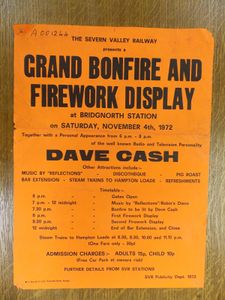 1972 Bonfire Night poster

At the AGM of the SVRA on 11 November, the members voted unanimously for the Association to continue. Association Chairman John Garth reported in SVR News "I have been asked for the benefit of members to sum up briefly the position of the three organisations on the Railway. As I understand it, the Holdings Company takes responsibility for all financial matters, the Guarantee Company is responsible for the operation of the Railway, and the Association does everything possible to safeguard members' interests and support the Railway. We have an extremely forceful Chairman of the two Companies, and it would appear to me at the present time that the Railway is subject to virtually a one-man dictatorship."[6]
December 1972[edit | edit source]
On 30 December Sir Gerald Nabarro announced on behalf of the Board that SVR(H) was fully capitalised at £150,000, and that the Southern section of the line to Foley Park had been purchased from BR subject to Light Railway Orders being granted.[7] The share issue that he had fronted had thus been a success.
Steam locomotives used[edit | edit source]
A table of steam locomotives used and their mileages can be found on the Steam Locomotive Mileages page.
See also[edit | edit source]
| ||||||||||||||||||||||||||||||||||