Severn Valley Railway Timeline 1974

This page provides a timeline of events on the Severn Valley Railway during 1974. During the year the SVR began services to Bewdley and increased the amount of daily running during summer, resulting in a near tripling of the miles covered.
Early 1974[edit | edit source]
Preparations continued for reopening the extension to Bewdley, in particular the provision of watering facilities there. By 12 January the concrete bases and underground pipework for the two water columns were in place. The water columns were installed on two weekends in late January, and both tanks were lifted into place on 16 February using a hired 25-ton crane.[1]
March 1974[edit | edit source]
The season opened on Saturday 2 March, with services running as far as Hampton Loade. The timetable intended for services to Bewdley to begin from that date; however a number of factors led to a delay including obtaining the Light Railway Transfer Orders, completing the infrastructure work at Bewdley, and the need to replace the underbridge at Highley, for which an order was hastily placed with Rubery Owen Limited.
The signal box at Highley was commissioned on 2 March, with Electric Token working replacing the former "one engine in steam" operation.[2] Also in early spring, the old Highley Station Footbridge was demolished after being considered heyond economic repair.[3]
-
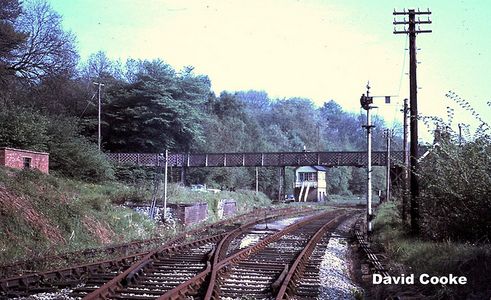 The original Highley Footbridge
(David Cooke)

During the first weeks in March, scaffolding was erected around the Bewdley water columns for painting and the installation of fittings including the booms.[1]
The Light Railway Transfer Orders were granted on 28 March, empowering SVR(H) to operate the railway between Bridgnorth and Bewdley (and as far as Foley Park).[4][note 1]
April 1974[edit | edit source]
Easter weekend, 13 April, saw the official start of services between Hampton Loade and Highley (an unadvertised service began on Good Friday 12 April to give operating staff a practice run, although some passengers were carried). The first passenger service on each day was the 09:30 from Bridgnorth with GWR Railcar 22, followed by the 12:45 steam service hauled by No 600 Gordon. The weekend saw 16,000 passenger journeys, including almost 6,000 on Easter Monday.[4][5]
-
 1974 poster advertising services to Highley

The girders and other sections for the Highley underbridge were delivered on 10 April 1974, and installed by the P.W. Department over the next 2 days. The deck timbers were replaced on 21 April and other works completed in time for the delayed opening of the Highley to Bewdley section the following month.[6].
During April 1974 Bridgnorth was demoted to rural borough status, losing its powers to spend money maintaining the footbridge outside the station. Later in the year the footbridge was sold to the SVR for a nominal £1.[7]
May 1974[edit | edit source]
The line was further opened from Highley to Arley and Bewdley on 18 May. GWR Railcar 22 operated the first round trip between Bridgnorth and Bewdley, while the first steam services were hauled by No 5764 from the new MPD at Bewdley and No 43106 from Bridgnorth. Daily running during the summer season was extended to five weeks.[8]
On the same day the Great Western (SVR) Association held its first Annual General Meeting.[9] It had formed from the merger of two earlier groups, the Great Western Rolling Stock Fund and the Great Western Locomotive and Carriage Society.
German 064 Class 2-6-2T No. 064.305 was purchased on 27 May.[10]
Following the re-opening to Bewdley, the "Kidderminster Shuttle" produced a colour supplement to mark the event. Richard Dunn wrote a foreword for this which included the statement "It is interesting to note that the Station at Bewdley will shortly be available for the use of visitors to the West Midland Safari Park by means of a footbridge recovered from the former Burlish Halt, to be erected on the island platform."[11] The Civil Engineering Department were planning to start work on the construction "shortly",[12] although this never took place.
Another major project which also never came to fruition was under way at the time by the S&T Department. Following an inspection in April 1972 in advance of the SVR re-opening to Bewdley, Maj. Olver of the Railway Inspectorate had recommended that the level crossing at Northwood Halt should be fitted with gates capable of closing across the road and the line as appropriate. A great deal of time had been expended in planning the installation of the ex-Burlish Crossing gates, which were to be hand-controlled by a locking lever in a three lever ground frame, the other two levers being used to work distant signals.[13] In the event, the gates were never installed, and the temporary procedure of a hand signalman being required to be present during operations continued until the Department of Transport sanctioned it becoming an 'open' crossing in 1980.
July 1974[edit | edit source]
On 14 July 46521 became the SVR's first Barry restoration to enter service.[14]
August 1974[edit | edit source]
2047 Warwickshire made a guest appearance in steam at the Town & County Show at Stoneleigh. Remarkably, the locomotive covered 8½ miles on a temporary track only 40 ft long![14]
November 1974[edit | edit source]
The Guarantee Company AGM was held on 1 November. The Charity Commission had given its opinion that the Company was not eligible for charitable status, being too closely connected with the Holdings Company under the contract of 16 June 1973.[15]
On 3 November the ex-Yorton signal box was moved by rail from Eardington to Arley.[16]
-
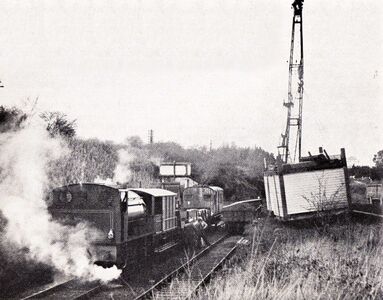 Yorton box at Eardington
(John Hollowood/SVR News)

During the month, the Civil Engineering Department began their largest project to date, the erection of the new loco shed at Bridgnorth. The first stage which took several months involved removing the two stores buildings which occupied the proposed site, a steel clad timber-frame building, and a concrete "Exeter" shed.[17]
-
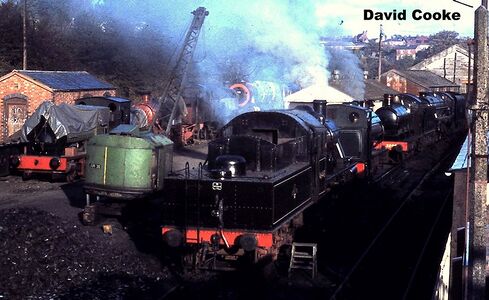 Bridgnorth MPD in 1972 with the two sheds visible
(David Cooke)

December 1974[edit | edit source]
At Arley, work began on relaying the passing loop (the Up line nearer to the station building). Reinstatement of the loop would allow trains to use Platform 1 for the first time, although passing trains would require the commissioning of the signal box.[18]
Steam locomotives used[edit | edit source]
A table of steam locomotives used and their mileages can be found on the Steam Locomotive Mileages page.
See also[edit | edit source]
| ||||||||||||||||||||||||||||||||||
Notes[edit | edit source]
References[edit | edit source]
- ↑ 1.0 1.1 SVR News 31, p. 17.
- ↑ SVR News 31, p. 36.
- ↑ SVR News 31, pp. 14-15.
- ↑ 4.0 4.1 SVR News 31, p. 1.
- ↑ SVR News 31, pp. 6-7. and 32, pp. 22-23.
- ↑ SVR News 32
- ↑ Marshall (1989) p. 105.
- ↑ SVR News 32, pp. 4-5.
- ↑ SVR News 32, p. 20.
- ↑ SVR News 32, p. 8.
- ↑ SVR News 32, The re-opening of the railway to Bewdley - An article from the "Kidderminster Shuttle" by R. H. Dunn.
- ↑ SVR News 32, p. 29.
- ↑ SVR News 32, pp. 34-35.
- ↑ 14.0 14.1 SVR News 33, pp. 7-10.
- ↑ SVR News 33, Boardroom Notes
- ↑ SVR News 34, p. 12.
- ↑ SVR News 34, p. 13.
- ↑ SVR News 34, p. 25.