Severn Valley Railway Timeline 1965

This page provides a timeline of events on the Severn Valley Railway during 1965, they year in which preservation began.
After closure of passenger and goods services at the north end of the Severn Valley Branch in 1963, the section between Buildwas and Alveley Colliery sidings was effectively abandoned by BR. In 1964 BR's District Engineer at Wolverhampton had ordered the track to be taken up from Buildwas southwards, to be reused in expanding Bescot yard. By the time the gangers and lengthmen had reached the north end of Bridgnorth station, sufficient rail had been recovered for that purpose. Fortuitously they were then re-deployed on upgrading the Stourbridge to Smethwick line, rather than completing the dismantling all the way to Alveley Colliery.[1]
Elsewhere in the area, on the Wyre Forest Line regular passenger services from Bewdley had ended in July 1961, with an experimental daily school service to Tenbury Wells ending the following year. The daily Tenbury goods had ended in January 1964, with the line beyond Cleobury Mortimer being used for storage of condemned wagons and progressively dismantled. By early 1965 the Admiralty had announced the closure of the depot at Ditton Priors and only a few goods services still ran via Bewdley and Cleobury Mortimer 'as required'. Passenger services on the Wellington to Craven Arms Railway, which connected with the Severn Valley Branch at Buildwas, had also ended in 1962.
April 1965[edit | edit source]
Keith Beddoes, a railway enthusiast from Kidderminster who had been considering the possibility of preserving part of the Severn Valley Branch, visited Bridgnorth and Hampton Loade and began making tentative enquiries.[1]
On 16 April the last 'run as required' freight traffic ended on the Wyre Forest Line.[2]
May 1965[edit | edit source]
On 8 May, electric token working was withdrawn between Cleobury Mortimer and Bewdley North signal box, with the remaining part of the Tenbury Branch being worked as a siding while demolition continued until 1966.[2]
June 1965[edit | edit source]
On Friday 25 June 1965, the 'Kidderminster Shuttle' reported that BR had withdrawn the 8.30am 'Cathedrals Express' service from Kidderminster to London. Keith Beddoes discussed this with a group of colleagues at work. The subject changed to the attempts to reopen part of the Bluebell line, and Beddoes suggested that the same could be done here.[3]
Letters were written to the local press over that weekend, and on Monday they responded, suggesting a meeting. This took place at the house of Tony Tuite, a colleague of Beddoes, on the evening of Tuesday 29 June. Those present decided to organise a public meeting and arrangements to advertise this were put in hand[3].
July 1965[edit | edit source]
The formation of the Severn Valley Railway in preservation officially began on 6 July 1965. The public meeting proposed by Keith Beddoes took place at the Coopers Arms in Kidderminster, attended by around 50 people.
The meeting was chaired by Tony Tuite with a presentation by Keith Beddoes. Three possible locations were considered for the potential preserved railway, and the meeting spent some time discussing the merits of these. It was not considered feasible to use a section of the Tenbury Branch between Bewdley and Cleobury Mortimer as BR were still using Bewdley station at that time and could not grant access. The Cleobury Mortimer and Ditton Priors Light Railway was also deemed unsuitable because of its remoteness and the relatively light axle load limits of the light railway. The Severn Valley Railway between Bridgnorth and Hampton Loade was therefore chosen.
Those present agreed to form the Severn Valley Railway Society ("the Society"). A committee of 8 was appointed, and the initial membership subscription was proposed as £1, but eventually set at 1 guinea (£1+1shilling) at the suggestion of John Garth, in order to increase funds.[4]
On Sunday 11 July the Society visited the three stations at Hampton Loade, Eardington and Bridgnorth.[5] While holding up the old station name board at Bridgnorth to take a photograph, they were challenged "What the hell do you think you are doing?" by a man with a shotgun. This turned out to be George Thorpe (also known as 'Elias') who had continued to operate the station refreshment room after the station itself had shut. Once the Society explained their idea, they were quickly made welcome![4] A home movie of the visit can be seen in The Engine House. On Friday 16 July a photograph of 18 of the 'pioneers' was published in the Kidderminster Times.[6]
Screenshots from a home movie of the visit on 11 July:
-
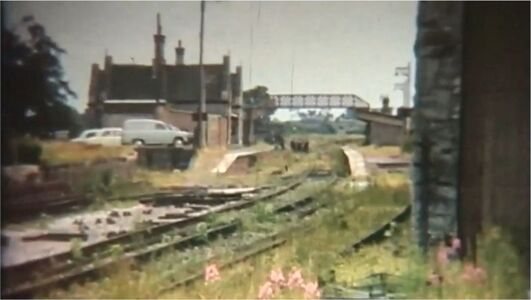 The station seen from near the goods shed
 -
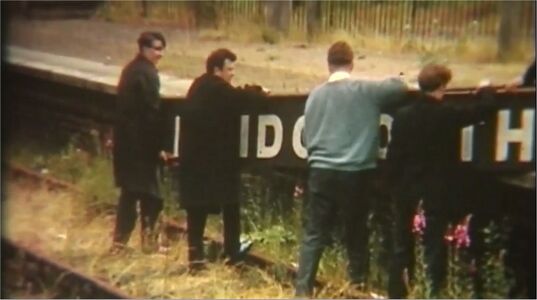 Society menbers lifting the station name board onto the platform
 -
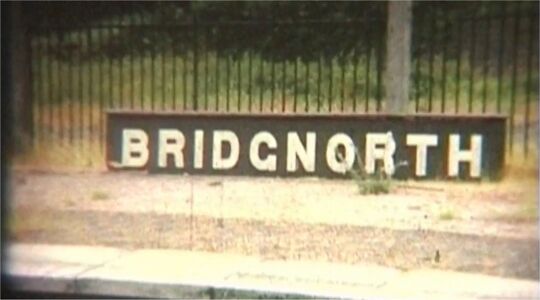 The station name board
 -
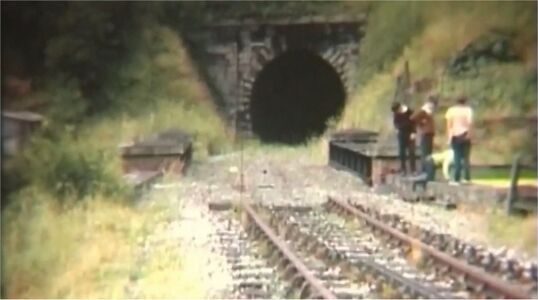 Bridgnorth tunnel and the extend of track lifting to that time


On Sunday 25 July, the Society made a second visit to inspect the line between Hampton Loade and Bridgnorth, noting that all the signals and most of the railway installations along the route had been removed.[7] They discovered that since their first visit, BR had resumed the removal of track from Bridgnorth Station towards Kidderminster. The Society authorised John Garth to send a telegram to British Rail asking them to stop taking up the line. This was sent on Monday 26th, and at 5pm on 28 July BR agreed to a stay of execution while negotiations took place.[7]
August 1965[edit | edit source]
The Society's initial goal was to operate services over the 4½ miles between Bridgnorth and Hampton Loade. However the Society would also need to take on the track between Hampton Loade and Milepost 144½ near Alveley in order to maintain a connection to the main line via the section beyond, which BR was still using for colliery traffic from Alveley Colliery.
The Society met with BR on 4 August. BR proved unwilling to lease the line to the SVR, and suggested a provisional price of £45,000 for the outright purchase of line between Bridgnorth and Milepost 144½ at Alveley Colliery. At the same meeting BR granted the Society access to the Bridgnorth Station site in exchange for a nominal rent of £5 per month.[8].
A public meeting took place at Kidderminster on 9 August, attended by between 70-100 people. The majority of those attending supported the plans, although some felt the provisional price of £45,000 was too high. Dissent was mainly from representatives of other Midlands preservation societies.[7][8]
Another public meeting took place at Bridgnorth on 31 August, attended by between 50-80 people. The proposals were generally well received[7][8].
September 1965[edit | edit source]
On 19 September 1965 GWR locomotives 4555 and 1420 visited Alveley Sidings with the Worcester - Wolverhampton - Worcester leg of the Stephenson Locomotive Society (Midland Area) 'The Restored Engines Tour'. This helped publicise the nascent preservation scheme, with leaflets being passed out on the train. Future resident 3442 The Great Marquess hauled the remainder of the tour.[9]
-
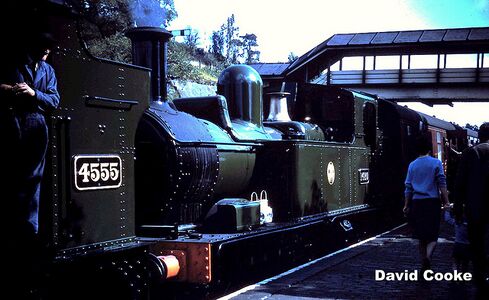 The SLS special at Bewdley
(David Cooke)

The first working party took place at Bridgnorth station on Sunday 26 September.[7] Regular Sunday afternoon de-weeding of the track and painting of the buildings continued throughout the 1960s as the station was gradually restored to working condition.
-
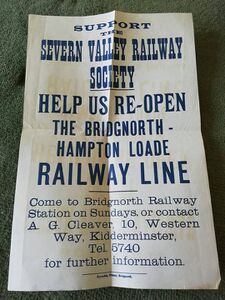 Early SVRS poster

October 1965[edit | edit source]
Having obtained a professional valuation of the station buildings, the Society posted a tender to BR Estates on 21 October offering £25,000 for the line from Bridgnorth to milepost 144½. On 26 October four members of the Society, led by John Garth, met with BR to discuss this[4][7].
November 1965[edit | edit source]
The first edition of SVR News was produced, edited by Paul Wyers.
Steam locomotives used[edit | edit source]
A table of steam locomotives used during the 1960s and their mileages can be found on the Steam Locomotive Mileages page.
See also[edit | edit source]
| ||||||||||||||||||||||||||||||||||
References[edit | edit source]
- ↑ 1.0 1.1 Marshall (1989) p. 165.
- ↑ 2.0 2.1 Beddoes & Smith (1995) pp. 197-98.
- ↑ 3.0 3.1 Magner (1997), pp 60-64, "Personal memories of Mr Keith Beddoes"
- ↑ 4.0 4.1 4.2 SVR News 191, Fifty Years Ago, Christopher George
- ↑ SVR News 190, p. 24.
- ↑ Marshall (1989) p. 167.
- ↑ 7.0 7.1 7.2 7.3 7.4 7.5 Magner (1997) pp. 43-46.
- ↑ 8.0 8.1 8.2 SVR News 189/190, “The Early Days of the Severn Valley Railway”, A.G. Cleaver
- ↑ Six Bells Junction