Severn Valley Railway Timeline 1983

This page provides a timeline of events on the Severn Valley Railway during 1983, a year of anticipation as the SVR moved ever closer to its goal of reaching Kidderminster. BR ran a DMU service between Kidderminster and Bewdley on Steam Gala saturdays in April, June and September.[1]
Passenger numbers for the year totalled 173,968.[2]
January 1983[edit | edit source]
The new steelwork for Bridgnorth Bypass Bridge was delivered and installed in the first week of January. During the rest of the month a polythene "tent" was installed to provide a "cocoon" to maintain the temperature after the concrete was poured. Scaffolding was installed to support the shuttering used to form the concrete deck, and the reinforcing bars put in position and secured.[3]
257 Railway Squadron took over the SVR between 14-16 January and staged simulated warfare between Bewdley and Highley, much to the surprise of local residents.[1]
Highley received the 'Best Preserved Station 1982' award at a ceremony in London on 31 January.[1]
February 1983[edit | edit source]
The concrete for the by-pass bridge was poured on 9 February; fortuntely the "cocoon" had been installed as the first three nights had the most severe frosts of the winter. The track was relaid in a mammoth session by the Railway's entire P-Way staff on 27 February. The 6-ton steam crane was first to cross the new bridge, folowed next day by 43106, 80079 and 4930 Hagley Hall returning from main line duties at Hereford.[3]
March 1983[edit | edit source]
The by-pass bridge was completed on time and within budget. The line re-opened on 5 March 1983, with 80079 hauling the first passengers across the new bridge.[4]
SVR News included announcements from two new groups on the SVR seeking funding. The Class 08 Society had been launched, intending to acquire a vacuum fitted BR Class 08 shunter to be used on the SVR for ECS moves, P-Way work and other shunting purposes.[5]. With the help of generous loans, purchase of 08015 was secured in early April and movement to Bewdley was completed by Friday 27th May.[6] The "Exeter West Project", led by Peter Jordan, was hoping to preserve for posterity the large signal box from the west end of Exeter St. David's Station.[7]
April 1983[edit | edit source]
686 The Lady Armaghdale left for a 2-month visit to the Birmingham Railway Museum, playing an active part in celebrations commemorating Tyseley's 75 years as a steam locomotive depot.[8]
The Spring Steam Gala was held on on 23-24 April. Jinty 47383 returned to service for the first time since 1979.[9]
SR 30777 Sir Lamiel (the first Southern loco on the SVR in preservation)[10] and BR Standard Class 9 92220 Evening Star arrived on visits to the SVR. On the late afternoon of Saturday 30 April, less than 2 months after re-opening, Bridgnorth was again isolated. A major collapse of the embankment occurred around 20 yards south of the new bridge, closing the line and the riverside road to Highley below it. Fortunately both locomotives were south of the embankment collapse at the time, so were able to work between Bewdley and Hampton Loade during their stay.[11]
-
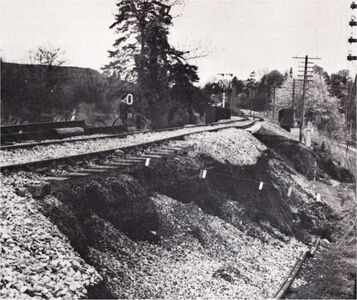 A view after the embankment collapse, looking north.
Alan Castle / SVR News

May 1983[edit | edit source]
After the collapse, services ran between Bewdley and Hampton Loade with up to 4 motor coaches per day providing a shuttle service between Hampton Loade and Bridgnorth. Following the Monday Bank Holiday, a site meeting was held at Bridgnorth on Tuesday morning between the Council, the Consulting Engineers and the SVR. Work began that afternoon and continued 14 hours per day 7 days per week. Shropshire County Council deployed their direct labour force on a 'without prejudice' basis and worked jointly with the SVR to reopen the line on Wednesday 18 May. 92220 Evening Star had the dubious honour of hauling the first service over the repaired embankment.[11]
The collapse also affected the Western Locomotive Association's Spring Diesel Weekend, which was to have been held on 7-8 May. It was the third time in five years this had been cancelled or curtailed, following previous collapses at Sterns and Folly Point.[11]
Filming of the BBC 2 Wales play The Fasting Girl took place at 'Pencader' (Arley) using LNWR Ramsbottom 0-4-0 saddle tank 143.[12]
Kidderminster Goods Depot was formally closed by BR on 16 May, and negotiations began in earnest with BR on leasing or purchasing an area of land in the freight yard to establish the SVR's proposed new station. A separate but related negotiation also began to purchase the sidings at Foley Park and the remaining section of the branch line between Foley Park and Kidderminster.[11]
June 1983[edit | edit source]
During the Great Western Weekend on 18-19 June, 686 The Lady Armaghdale acted as station pilot at Highley as part of the celebrations to commemorate the centenary of Highley signal box. [8] Only three GWR locomotives were available (7812, 4930 and 5164); plans to steam newly-repaired 3205 were thwarted after a thrush had taken up residence in the cab and hatched its young.[13]
September 1983[edit | edit source]
The Autumn Steam Gala took place on 10-11 September.
Action on the SVR on 10 September 1983 (Wikimedia Commons):
-
 3205 and 46521 depart from Bridgnorth
 -
 47383 at Highley
 -
 A BR Bewdley to Birmingham New St shuttle service


On Saturday 24 September D1013 Western Ranger hauled a special train chartered by the Western Locomotive Association as part of a weekend celebrating the 21st anniversary of D1013's entry into BR service.[14]
October 1983[edit | edit source]
The 'Severn Valley Enterprise' railtour from Bridgnorth to Paddington on Saturday 8 October, organised by the St. John's RC Primary School Parents' Association, was the last train over the Foley Park to Kidderminster section in BR ownership. Due to a late arrival of the BR stock, 4930 Hagley Hall with the Severn Valley Limited worked from Bridgnorth to Bewdley, where BR's 25048 and 25236 took 11 blue and grey carriages as far as Coventry. BR's 37069 and 37215 then worked the set to Paddington and back to Coventry, where 20185 and 20193 completed the return to Bewdley. After the return ECS move, BR closed the line from Foley Park to Kidderminster Junction.[15]
November 1983[edit | edit source]
The SVR launched a share offer on 16 November to raise money for the new station. The initial target was £300,000 with a minimum of £90,000 by 29 February 1984.[16] (£230,000 was achieved by the deadline, the total exceeded £370,000).
The Board announced a number of changes to the locomotive fleet. 45690 Leander had been acquired from 'Leander Locomotive Limited' (LLL). The purchase also included unrestored sister 45699 Galatea, then at Carnforth, which could be restored or used as a source of spares for Leander. To finance the deal, the Ivatt Class 2 46443 had been sold to LLL and would move to Loughborough in June/July 1984. Finally WD 193, which had been on loan to Hereford since January 1981, was in the process of being sold.[16]
December 1983[edit | edit source]
Four locos hauled 31,450 passengers on the Santa Special services, with a further 2,184 on the post-Christmas 'Mince Pie specials'.[2] A decade earlier a single saddle tank WD 193 had done the job single-handed.
Steam locomotives used[edit | edit source]
A table of steam locomotives used and their mileages can be found on the Steam Locomotive Mileages page.
See also[edit | edit source]
| ||||||||||||||||||||||||||||||||||
References[edit | edit source]
- ↑ 1.0 1.1 1.2 SVR News 67, General Manager's Notes, Michael Draper
- ↑ 2.0 2.1 SVR News 71, General Manager's Notes, Michael Draper
- ↑ 3.0 3.1 SVR News 67, pp. 10-11.
- ↑ SVR News 67, p. 13.
- ↑ SVR News 67, p. 18.
- ↑ SVR News 68, p. 35.
- ↑ SVR News 67, p. 33.
- ↑ 8.0 8.1 SVR News 70, pp. 20-24.
- ↑ SVR News 68, p. 28.
- ↑ SVR News 68, p. 1.
- ↑ 11.0 11.1 11.2 11.3 SVR News 68, General Manager's Notes, Michael Draper
- ↑ SVR News 68, p. 34.
- ↑ SVR News 68, pp. 12-15.
- ↑ SVR News 70, p.p. 26-27.
- ↑ SVR News 70, pp. 29-31.
- ↑ 16.0 16.1 SVR News 70, General Manager's Notes,, Michael Draper