Severn Valley Railway Timeline 1966

This page provides a timeline of events on the Severn Valley Railway during 1966.
Durng the year, regular Sunday working parties continued at Bridgnorth while fund raising to purchase the line got under way.
February 1966[edit | edit source]
On 1 February 1966 the Severn Valley Railway Society met with BR, who agreed to the £25,000 offer for purchase of the line and buildings between Bridgnorth and Alveley Sidings, subject to contract and subject to a light Railway Order (LRO) being granted by the Ministry of Transport. A 10% deposit would be required, although fortunately BR did not require immediate payment.[1] The agreeement was announced to the public on 3 February, followed by an Extraordinary General Meeting of the Society on 5 February.[2][note 1]
On Sunday 13 February a film unit from BBC's 'Midlands Today' visited Bridgnorth. The feature was shown on the following Wednesday, giving good publicity to the Railway.[3]
On Wednesday 23 February[note 2] BR's District Engineer and his assistants travelled from Bewdley to Bridgnorth to inspect the line. BR Standard Class 4 76039 from Oxley Shed hauled the Engineers' saloon.[4]
Paul Wyers produced the second edition of Severn Valley Railway News.
March 1966[edit | edit source]
Solicitor Richard Dunn began to act in a legal capacity for the Society, to assist with the process of obtaining the two Light Railway orders necessary to purchase the Railway.[5]
May 1966[edit | edit source]
The rest of 1966 was taken up with raising £2,500, the deposit of 10% for the purchase of the railway. Bridgnorth Station saw regular 'Open Weekends', the first being an exhibition of railway relics in connection with Bridgnorth Arts Festival, over the 29-31 May Bank Holiday weekend. This event included a steam roller operating in the road outside the station.[6]
Representatives of the Society met with Chelmarsh Parish Council and the Shropshire County Council Surveyer, to hear objections to the scheme based on the road clearances of three of the bridges on the line.[5][note 3]
July 1966[edit | edit source]
The second Open Weekend on 9-10 July was held to celebrate the first anniversary of the preservation society. The event featured a number of road traction engines in the station yard. A 5in gauge miniature railway was set up on Platform 2 with 50 yards of track, on which a train hauled by a 'Hall' and 'Pannier' gave rides to children. Almost 1,000 visitors paid the 1/6d admission fee.[6] The Society membership has passed 300 within the first year.[7]
The Society produced two new posters, one 30"x20" depicting a Pannier Tank, and one 9"x12" (pictured) depicting an LMS Ivatt 2-6-2 tank. Other methods of publicity were akso being explored, including advertisements in the July and August editions of The Railway Magazine.[7]
-
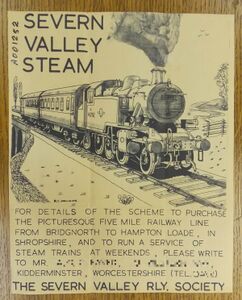 Early SVRS poster

The Society purchased from BR £70 worth of ballast from Bridgnorth tunnel.[8] Volunteers temporarily relaid the track into the tunnel so it could be removed before the rail connection to the tunnel was severed by the planned demolition of the Hollybush Road bridge.[9]
David Williams assumed the role of Severn Valley Railway News editor,[note 4] producing Issue 3 in July.
September 1966[edit | edit source]
On 23 September the Society paid a deposit of £1,150 to the British Railways Estates Department for use of the Bridgnorth station site.[10]
The third Open Weekend on 24-25 September was the last without steam traction. A fairground including roundabouts, swings and dodgem card was set up behind platform 2. 1,500 visitors attended, raising £200 for the funds.[6]
November 1966[edit | edit source]
The Society's first AGM took place on on 26 November, with 110 members crammed into the Station booking hall. There were no nominations for Chairman, with the meeting approving the forming of a 'council'. Other officers re-appointed included Alan Cleaver as Secretary, Richard Dunn as the Society's Solicitor, and David Williams as SVR News Editor. The meeting was informed that BR had stated that the track was in sufficiently good condition to take a locomotive, and that 3205 had been given clearance and would arrive with two coaches 'shortly'.[5][note 5]
Richard Dunn outlined to the meeting the process that would need to be followed. Operating authority from the Ministry of Transport would be required before the Railway could be bought from BR. BR would need to apply for a Railway Order to downgrade the line from "secondary railway" to "light railway" status. Once this was granted, a new Company (which would need to be formed) would apply for a Light Railway Order (LRO) to transfer responsibility for the line; the Society itself not being able to apply for legal reasons.[5]
Steam locomotives used[edit | edit source]
A table of steam locomotives used during the 1960s and their mileages can be found on the Steam Locomotive Mileages page.
See also[edit | edit source]
| ||||||||||||||||||||||||||||||||||
Notes[edit | edit source]
- ↑ Smith referred to this as the first Annual General Meeting; SVR News 2 described it as an Extraordingy General Meeting.
- ↑ The day and date is from SVR News 2. Magner dated the visit to 22 February.
- ↑ By the time of the November AGM these objections were not thought to be as serious as at first; Highley Parish Council had withdrawn its objection to the scheme. The objections nevertheless remained an issue until after the Public Enquiry in 1968.
- ↑ David Williams held the role for more than 57 years until 2023, producing 222 editions of the magazine.
- ↑ 3205 eventually arrived with four coaches in March 1967.
References[edit | edit source]
- ↑ SVR News 189/190, The Early Days of the Severn Valley Railway, A.G. Cleaver (with annotations by Chris George)
- ↑ DJ Smith (1968) p. 28.
- ↑ SVR News 2, Secretary's Report
- ↑ Magner (1997) p. 46.
- ↑ 5.0 5.1 5.2 5.3 SVR News 4, The Annual General Meeting
- ↑ 6.0 6.1 6.2 SVR News 11 article 'Open Weekends'
- ↑ 7.0 7.1 SVR News 3, Publicity
- ↑ SVR News 3, Working Party Report
- ↑ Magner (1997) p. 47.
- ↑ Magner (1997) p. 48.