Severn Valley Railway Timeline 1973

This page provides a timeline of events on the Severn Valley Railway during 1973. By early 1973, the SVR was receiving considerable adverse publicity in the national press over some of the decisions made by the Board of SVR(H), in particular the dismissal of Arthur Becker, the Railway’s Operating Superintendent and Shedmaster, from his salaried post. This decision had caused uproar amongst the volunteers and raised the very real possibility of a strike.
January 1973 edit
On 1 January three new Directors were appointed to SVR(H), Michael Draper, TJ Holder (former MD of the Dart Valley Railway Company) and TJ Willis.[1] Terence Willis, a property developer, appeared on the share register on 2 January as holding 15,000 shares in SVR(H), representing 10% of the share capital. (He also acquired a further 200 shares on 30 May). Nabarro also had the Bridgnorth site valued, ostensibly on the grounds of knowing its value should the SVR not be able to finance the by-pass bridge. The members undoubtedly saw this, and other of Nabarro's decisions, as a threat to sell off the Bridgnorth site.[note 1][2]
4141, 5164, 7819 Hinton Manor and 4930 Hagley Hall[note 2] all arrived on 6 January. The convoy left Barry Scrapyard behind ‘Peak’ diesel No 157 for Kidderminster (still then a British Rail yard), where it arrived in a whiteout of heavy frost. Two other vehicles were in the consist: the tender from scrapped ex-LMS ‘Black Five’ 44888 and 73129. After the SVR locos were detached at Kidderminster, this loco continued its journey to Derby. From Kidderminster Sulzer Type 2 No 7655 tripped the vehicles to the SVR in Bewdley Down Yard, together with 6045, 9615 and 26880.[3]
February 1973 edit
On 17 February an EGM of the Severn Valley Railway Association approved a formal Constitution, whereby it became a legally constituted body.[4]
Following the announcement at the November 1972 AGM, an amended contract between SVR(H) and the Guarantee Company was signed on 24 February. The Guarantee Company Board also formally approved the SVR(A)'s constitution, with the SVR(A) being a signatory to the new agreement. Under the new contract the Guarantee Company could nominate two Directors to the SVR(H) Board and the SVR(A) one Director. Also on 24 February the SVR's Civil Engineer was instructed to prepare the appropriate planning application for the By-Pass Bridge.[5]
The first stage of the Light Railway Order for the southern end of the line came into effect on 28 February. The British Railways Board (Severn Valley) Light Railway Order 1973 granted BR the power (to be transferred to the SVR) to operate as a Light Railway from the existing boundary at Alveley to a point 247 yards east of the Stourport Road Bridge. Power was also granted to operate over the Stourport Branch from Bewdley to a point 302 yards south of the southern portal of Mount Pleasant Tunnel, this section having been purchased by the SVR for an additional £100.[6]
March 1973 edit
A special meeting of the Guarantee Company Board took place on 11 March to consider the dispute between Sir Gerald Nabarro and the volunteers, regarding the dismissal of Arthur Becker. A long joint meeting of the boards of SVR(H) and the Guarantee Company then took place on 17 March. Nabarro defended his position, noting the Railway's trading profits and relatively low debt which he attributed to his management. Following the meeting an agreed statement was issued. This confirmed that:[7]
- Mr. Becker accepted his dismissal and offered to continue as Shedmaster in a voluntary capacity and as Acting Operating Superintendent until the next SVR(H) AGM or the appointment of a properly qualified full-time replacement.
- Sir Gerald Nabarro would step down as Chairman of both Boards, while remaining as a Director, until the next SVR(H) AGM at which he intended to stand again for the Board.
- The Directors of both Companies agreed to these offers.
- The Direcors of SVR(H) had elected Viscount Garnock as Chairman.
- The Direcors of the Guarantee Company had elected Richard Dunn as Chairman.
- The two proposed nominee Directors of the Guarantee Company would become members of the SVR(H) Board
- A representative of the SVRA would 'sit in' at SVR(H) Board meetings
78019 arrived from Barry Scrapyard on 12 March, 7714 arrived on 29 March and 75069 arrived on 31 March.
April 1973 edit
The West Midland Safari Park opened on 16 April.[8]
May 1973 edit
An Extraordinary General Meeting of the Guarantee Company, attended by around 300 Members, was held on 18 May to discuss the By-Pass Bridge, for which Richard Dunn had set out the options in an article in SVR News Issue 27, Spring 1973. He noted that "I have no reason to reverse my opinion of 1968 that Eardington was not a suitable permanent terminus to the line, owing to the difficulties of road access and inadequate parking space. However he then referred at length to the potential cost of the Bridge (estimated at £70,000) which together with the costs of implementing the southern section (£100,000) and raising additional working capital (£30,000) would require a further share issue of £200,000, probably by a 4 for 3 rights issue. Alternatively the potential proceeds of selling Bridgnorth for development were estimated at £150,000 which he noted could adequately capitalise the restoration and re-opening of the whole of the Southern Section, and re-equip the whole Railway with no need to raise further money. He concluded that "I anticipate that the maiority of our members will almost certainly sympathise with a personal wish to retain Bridgngorth, and thus complete the heavy task begun in 1965, so much of which has been done by voluntary effort. Nevertheless all members and shareholders must understand the financial extent of this major problem, and the commercial consequences of our embarking on it, before they vote, and the final decision is taken." The article as a whole read as a strong arguement in favour of abandoning the Bridgnorth site. However the meeting voted overwhelmingly voted in favour of raising the money to build the By-Pass Bridge, thus 'saving Bridgnorth for a second time'.[8]
Hampton Loade signal box was recommissioned and signalling brought into use on 19 May 1973 after the last train of the day returned to Bridgnorth.[9] Initially it worked to Bridgnorth using One Engine in Steam, and then Electric Token Block from 2 June after the commissioning of the token instruments.[10][11]
Sir Gerald Nabarro resigned from the Boards of both companies on 24 May.[12]
June 1973 edit
By June 1973 the atmosphere on the railway had noticeably improved.[13]
LNER K2 3442 The Great Marquess was steamed for the first time since arrival the previous year.[14] After several test runs, it worked passenger services on 9 September.[15] With an axle weight in excess of 19 tons, it exceeded the limit of 17 tons 12 cwt in the SVR's Light Railway Order granted in May 1970. A condition of the locomotive's move to the SVR was that it could be used there once restored, so after one further steaming in 1974, it was stored while discussions took place over a possible transfer to another railway. In the meantime, a program of work was underway to upgrade the line, including replacement of several bridges, to raise the permitted limit to a figure in excess of 20 tons. This upgrade was achieved in due course.
Major Olver inspected the line on 13 June and reported favourably. However it was necessary for a resolution to be passed at the next Guarantee Company AGM in November authorising the transfer of the existing LRO to SVR(H) before a new LRO for the southern section could be granted.[16]
The SVR(H) AGM took place on 29 June. Having already resigned as a Director, Sir Gerald Nabarro did not stand again. However SVR News reported that "Considerable heat was generated over Mr. T. J. Willis' offer of £150,000 funds. While the Boards are well aware of members' misgivings, they do not wish to disregard such a substantial offer, and consideration is still being given as to whether sufficient safeguards of the present members' interests can be obtained to enable the offer to be accepted.".[16]
November 1973 edit
Services ceased at the end of October and the line was handed into "Engineers posession". Over the next six weekends the Cleobury Road Bridge underwent a major repair involving renewal of the bridge timbers.[17]
-
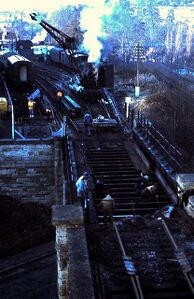 Overhaul of the bridge under way

The Guarantee Company AGM was held on Friday 2 November. Members had been informed by Richard Dunn via an article in SVR News that the DoE had advised that SVR(H) as proprietor of the line must hold all the LROs, and therefore that the Guarantee Company must resolve formally to transfer the existing LRO to SVR(H) (thus reversing the original proposals for the Guarantee Company to hold all the LROs). He also advised that he was seeking the advice of the Charity Commission with a view to obtaining charitable status for the Guarantee Company whose shareholding in SVR(H), then in excess of 25%, would make a hostile takeover of SVR(H) more difficult to achieve.[18]
A Bonfire Night event was held at Bridgnorth on 3 November. The event was was brought to a premature close by a disturbance caused by two gangs, so the SVR decided with regret that it would discontinue the event in future years.[19]
-
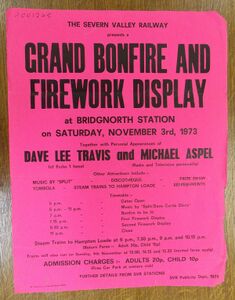 1973 poster

5764 was involved in the filming of the BBC children's serial Carrie's War at Highley on Monday 5 November. SVR personnel who appeared in the production included Station master Malcolm Broadhurst, guard Peter Jordan, and footplate crew John Hill and Jim Bodfish.[20]
At the SVRA AGM on 17 November John Garth stepped down as Chairman, having been appointed to the Board of SVR(H) in June. He was succeeded as Chairman by John Hill.[21]
Having left the SVR, Sir Gerald Nabarro died on 18 November 1973. He had suffered two stokes during 1972 and had recently retired from the House of Commons due to ill health.
December 1973 edit
Stanier Mogul 42968 arrived on 14 December.
Christmas services incorporating 'Santa Specials' were reintroduced afer 'several years absence', running on Saturday and Sunday 22-23 December, and Wednesday to Sunday 26-30 December with departures at 12.30 and 14.30 from Bridgnorth. WD 193 Shropshire provided the motive power..[22]
An agreement was signed with Rubery Owen Holdings Limited who would take out 150,000 shares in SVR(H). The intention was that the Railway would rebuild the Hollybush Road Footbridge which was built by the predeccesors of Rubery Owen. SVR News reported at the time that the voting rights of those shares were vested in Severn Valley Railway Company Limited.[23]
Steam locomotives used edit
A table of steam locomotives used and their mileages can be found on the Steam Locomotive Mileages page.
See also edit
| ||||||||||||||||||||||||||||||||||
Notes edit
- ↑ Nabarro also had a run round loop built at Eardington at considerable cost and moved the Railway's headquarters from Bridgnorth to Bewdley.
- ↑ 4930 had been bought by SVR(H) at the instigation of Sir Gerald Nabarro, contrary to the SVR policy up to that time that groups should acquire rolling stock while the Railway itself was still acquiring the line. Seen as a 'vanity project', it was another source of discontent among the volunteers.
References edit
- ↑ SVR News 26, p. 4.
- ↑ Marshall (1989) p. 180.
- ↑ Branch Lines, January 2023
- ↑ SVR News 27, p. 45.
- ↑ SVR News 27, p. 4.
- ↑ Marshall (1989), p. 184.
- ↑ SVR News 27, pp. 44-45.
- ↑ 8.0 8.1 Marshall (1989) pp. 184-5.
- ↑ SVR News 28, p. 26.
- ↑ SVR News 30, p. 26.
- ↑ Marshall (1989) p. 186.
- ↑ Marshall (1989) p. 183.
- ↑ SVR News 28, Editorial
- ↑ SVR News 28, p. 35.
- ↑ SVR News 29, p. 25.
- ↑ 16.0 16.1 SVR News 29, Guarantee Company Boardroom Notes
- ↑ SVR News 31, p. 34.
- ↑ SVR News 29, p. 8.
- ↑ SVR News 30, p. 6.
- ↑ SVR News 31, pp. 14-16.
- ↑ SVR News 30, pp. 12-13.
- ↑ SVR News 29, p. 4. and 32, p. 21.
- ↑ SVR News 30, p. 9.