Bridgnorth
.jpg)
Bridgnorth station is the northern terminus of the present day SVR. It was located near the middle of the original Severn Valley Railway, approximately 18 miles north of Hartlebury and 22.5 miles south of Shrewsbury, and was one of the five crossing stations at opening in 1862.
| Up (towards Kidderminster) | Down (towards Shrewsbury) |
|---|---|
| Hampton Loade (4½ miles) via Eardington |
Present day: line terminates. Pre closure: Linley |
The station edit
- Main article: The development of Bridgnorth Station in preservation
Bridgnorth has been the northen terminus of the SVR throughout preservation and was its original headquarters before they moved in turn to Bewdley and Kidderminster.
The station has two platforms connected by a footbridge, a yard, and a signal box. The original Severn Valley Railway continued northwards towards Ironbridge through a 550 yard long tunnel underneath Bridgnorth High Town. From time to time the possibility of re-opening the section of the line north of Bridgnorth is raised on discussion forums and elsewhere. The official stance of the SVR has over time varied between "maintaining a watching brief" and "the railway land north of Bridgnorth has been long since sold, and there is now no possibility of Severn Valley trains reaching Ironbridge and Shrewsbury ever again". An application by The Ironbridge Railway Trust in 2021 to the 'Restoring Your Railway Ideas Fund' was unsuccessful.
The main station building is listed Grade II by Historic England for its special architectural or historic interest.[1]
The yard at Bridgnorth is home to the Loco Works. Bridgnorth MPD (Motive Power Department) is the principal base for the Railway's steam locomotives. Bridgnorth is also home to two new build projects, BR Class 3 locomotive 82045 and a replica of the Trevithick locomotive Catch Me Who Can.
Day to day restoration and maintenance is carried out by a group going by the name of 'The Wailing Wall Construction Company plc (pretty limited craftsmen)'.
Facilities edit
Bridgnorth has two car parks. The entrance to the smaller coach/car park next to the station building is in Hollybush Road and includes disabled parking spaces. The entrance to the larger 'West' car park is at the end of Station Lane off Hollybush Road, 100 yards to the north of the main station entrance. For both an ANPR system operates, with visitors to the Bridgnorth Station Shop or 'The Railwayman's Arms' pub entering their registration number on a tablet to avoid parking charges.
Facilities for visitors include the gift shop, Refreshment Rooms and 'The Railwayman’s Arms' pub. High Town, with its Castle Gardens and Cliff Railway, can be accessed from the SVR via a footbridge outside the entrance to the Station building.
A lineside public viewing area is situated at the foot of Pan Pudding Hill, on the opposite side of the line from Platform 1. This can normally be accessed by taking the steps down from the car park near the Railwayman's Arms pub (the 'Donkey Gallops') and going through the Engine Shed Underpass. A flight of steps on the right then leads up to the viewing area. When access is allowed to the Bridgnorth Works (normally only during Gala events), access to the viewing area is possible direct from the south end of Platform 2.
Points of interest edit
Footbridge outside Bridgnorth Station edit
This view from Bridgnorth Station shows the footbridge connecting the station to New Road. It is sometimes referred to as the Hollybush Road footbridge, after the road which passes beneath it. The War Memorial in Bridgnorth High Town’s Castle Gardens can also be seen in this image.
-
 The new footbridge

The original footbridge at this location was built for Bridgnorth Corporation by Rubery Owen & Co. Ltd. in 1895 at a cost of £1400, for which the GWR contributed £95.[2] It had been delayed due to a landslip that occurred near to one of the buttresses.[3]
Its condition was allowed to deteriorate following the closure of the railway at Bridgnorth in 1963, and by 1967 owners Bridgnorth Council had announced plans for its demolition. A Public Enquiry into the future of the footbridge was held on 1 April 1968,[4] and a campaign to save the bridge was launched in 1969. The footbridge was closed and boarded up on 30 September 1970. In April 1974 Bridgnorth was demoted to rural borough status, losing its powers to spend money maintaining the footbridge. Later that year it was sold to the SVR for a nominal £1, but was reluctantly deemed beyond repair and demolished in 1976.[5] A short section was cosmetically restored by SVR volunteers and placed as a feature on the roundabout at the junction of the A458 and A442 on the outskirts of Bridgnorth.[6] The 1895 bridge can also be seen in photographs 8 and 9 in the gallery of Sellick photographs below.
-
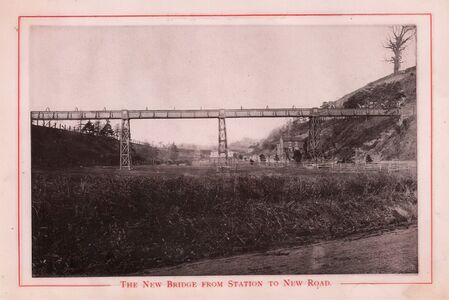 The original 1895 footbridge

The new footbridge was built under the auspices of the Bridgnorth Footbridge Trust and opened on 22 July 1994. Ownership of the footbridge later transferred to Shropshire County Council.
In January 2018 the footbridge was closed due to the station end lifting: it appeared the bridge was under tension and the bolts at either end had corroded, and so the bridge had come adrift at each end. Shropshire County Council instigated a temporary repair before the start of the running season with permanent repairs to follow.[7] The bridge was closed for 4 weeks in February 2020 for these repairs to be completed.
Platform 1 edit
The south end of platform 1 originally ended by the water tower, as can be seen in the picture by David Cooke below and in photographs 8 and 9 in the gallery of Sellick photographs. A 200 ft extension was added by SVR volunteers in 1981 using 30,000 bricks recovered from the ex-GWR goods shed at Cradley, coping stones from the former relief line platform at Acock’s Green, and fencing from Dunstall Park. At the same time contractors re-faced the original platform and raised the level at the south end.[8] There is a noticeable change in the appearance of the platform at the junction of the old and new platforms, which can be seen in this photograph.
In early 2016 volunteers completed a further extension of the platform at the north end.[9] This enabled 9-coach trains such as those with an additional observation saloon to be fully 'on platform'. The work also included replacing the adjacent 'barrow crossing'.[10]
-
 Bridgnorth Platform 1 in 1969 (David Cooke)
 -
 Bridgnorth Platform 1


The Railwayman's Arms edit
Bridgnorth Station building includes a licensed public bar, The Railwayman’s Arms. This remained open when the station was closed by BR in September 1963 - the group of potential preservationists who visited Bridgnorth in July 1965 were challenged by George Thorpe who ran it at the time.
The bar and cellar were extended in 1979, the contract for the work being awarded to the building contractors in February of that year.[11]
The pub has four different pub signs. Two, which feature paintings by John Austin of Ivatt 'Mickey Mouse' 46443 and GWR 7802 Bradley Manor, were on the platform side of the pub until late 2024, when they were swapped to the entrance on the car park side. They were replaced on the platform side by the other two signs which feature a fireman's arms and a speedometer, one labelled BR showing a speed in excess of 70mph (in fact the line speed on the Severn Valley Branch in service was never more than 50mph), the other labelled SVR showing a speed of 25mph (the maximum speed anywhere on the branch in preservation).
In February 2017 it won the CAMRA Bridgnorth Pub Of The Year Award 2017.
-
 The Railwayman's Arms occupies the south wing of the station building.
 -
 The '46443' sign
 -
 The '7802' sign
 -
 The 'BR' sign
 -
 The 'SVR' sign


Hanbury Cottage edit
Hanbury Cottage forms a distinctive backdrop to Bridgnorth MPD. The cottage, together with a half-acre of land, was bought by the SVR for £165,000 in May 2007 after it fell vacant.[12] By 2009 it had been converted into the MPD crew room with DSM and Inspector's offices, plus a small kitchen and a pattern store.[13] The 1884 OS Map below refers to the property as 'Ambrose Cottage'.
-
 Hanbury Cottage

Lighting edit
Current lighting installed on the site is 21st century, using period new GWR no 2 lampposts with associated luminaires and half-harps, plus corner brackets to match the original gas fittings. This was undertaken by suitably qualified volunteers with £60,000 raised by Bridgnorth Station Fund, and was mainly complete by 2021.[14]
It replaced reinforced concrete lighting, manufactured in Taunton by BR in the 1950s, evident in the image 1) from the Sellick collection in the below gallery. That lighting had begun to disintegrate and had become unsafe.
Pan Pudding Hill edit
Pan Pudding Hill, or sometimes Panpudding Hill or Pampudding Hill[15], is a scheduled ancient monument which overlooks Bridgnorth station.[16] The man-made hill was built in 1102, on the orders of King Henry I, as a siege earthwork to attack and capture Bridgnorth Castle. The distance from the hill to the castle, nearly 300 yards, is a testament to the power of medieval siege catapults.
Pan Pudding Hill was used to attack Bridgnorth Castle on other occasions, and finally in 1646 by Cromwell’s Parliamentarians during the English Civil War. After the last attack Bridgnorth Castle was blown up, leaving only the remains of the keep which can be seen in the castle grounds in High Town.[17]
In 2000 the TV series 'Time Team' visited Bridgnorth to investigate the area around St Mary’s Church.[18] Part of the dig concentrated on Pan Pudding Hill – then in the ownership of The Apley Estate.[19] The episode is available on YouTube. In October 2015 the SVR purchased ten acres of land to the west of Bridgnorth Station from The Apley Estate Trustees, which includes Pan Pudding Hill.[20]
A planning recommendation for the Bridgnorth refreshment rooms was for access to Pan Pudding Hill. Shropshire Wildlife Trust subsequently prepared a recommendation for the whole hill, including a steadily graded path in a zig-zag formation up the south face to the summit, for which the Railway would need the consent of Shropshire County Council. In October 2022 a Severn Trent Water team, as part of that company’s community assistance scheme, helped construct a flight of steps up to the fence alongside the headshunt, providing for future access.[21]
-
 Pan Pudding Hill, with the public viewing area below

Locomotive watering facilities edit
BR had already demolished the water tank on Pan Pudding Hill and the watering columns on platforms 1 and 2 before the fledgling SVR Society made contact in July 1965 asking them to stop demolition works while negotiations to buy the line took place. The SVR Society acquired replacement ‘rail level’ water columns from nearby Stourbridge MPD, and a replacement water tank from Henley in Arden, the latter arriving in August 1970. These were installed during the following year – until they were commissioned locomotives were watered at Eardington where possible, or otherwise from a simple hosepipe connected to a nearby tap at Bridgnorth.
In October 1972, the platform water columns from Henley were obtained with a view to replace those previously obtained from Stourbridge. During winter maintenance shut down in January 2020 the 30-ton steam crane lifted the constituent parts of the Platform 2 water column to deal with an internal leak and to replace a bearing at its base.
In 1980 Severn Trent Water re-connected the local water supply to a bore hole which supplied water with a very high level of dissolved salts. The water softening plant was unable to cope with this, resulting in boilers scaling and locomotives 'priming' within 3 days of a washout.[22] The following year, to resolve the issue, the SVR laid a water main to Bridgnorth from Knowlesands, the nearest source of softer water[8].
Weighbridge edit
All locomotives must be weighed before first use on the SVR to ensure they comply with axle weight limits. Individual wheels are also weighed to check for correct weight distribution after replacement of springs. A locomotive is moved slowly over a section of strain gauged track adjacent to platform 1 at Bridgnorth with the results displayed on a screen in the signal box.
-
 Weighbridge adjacent to Platform 1

Exhibitions edit
- From 16 June 2012 an exhibition was mounted for the Victorian weekend and following station festival in Platform 2 waiting room, with a history of the station.[23]
- On 24 June 2018 a Catch Me Who Can sculpture was unveiled as a part of the Bridgnorth Art Trail. The sculpture was one of twelve positioned around the town. They were aluminium castings that represent the locomotive in a much simplified form and were used as the ground for competition winning individual artists and groups to decorate. Statue 2: 'Just the Ticket' was positioned outside Bridgnorth station booking office and was designed by Tania Holland of Tania Holland Gallery using archive material provided by the SVR. It was also sponsored by the SVR.[24]
- From 16 to 30 August 2019 Kathryn O’Connor, a black and white photographic documentary artist, ran an exhibition in the then-new Bridgnorth Refreshment Room as part of the Bridgnorth Music & Arts Festival. It comprised a selection of individual people then working in Bridgnorth, in as many diverse workplaces as possible, and short work history questionnaires they had completed.[25]
Postmark edit

In 2004 a Bridgnorth postmark was used in conjunction with Royal Mail's Classic Locomotives stamp issue, which featured the SVR's Bradley Manor.
Bridgnorth history before preservation edit


- 1849 A goods conveyancing service by road to Wolverhampton Railway Station is advertised by a local carrier in partnership with the Grand Junction Railway.
- 1856 A passenger and parcels service by road to Shifnal Railway Station is advertised by the GWR.
- 1862: When the original Severn Valley Railway opened, Bridgnorth Station is the principal intermediate station and crossing point between Hartlebury and Shrewsbury. The station building is made of stone in a Jacobean architectural style.
- 1887: The down platform is extended, a passenger shelter is erected, and a cast-iron and wrought-iron lattice footbridge is built to connect it to the up platform.
- 1887: The Town Corporation pays for a new approach road to the station.
- 1892: Two fully interlocked signalboxes open at the north and south ends of the station, replaced in 1923 by a single central box on the up platform.
- 1895: The Town Corporation pays for a lattice footbridge to shorten the route from High Town to the railway, at a cost of £1,400.
- 1904: A steam bus service to Wolverhampton commences.
- 1922: Knowlesands Brick Works sidings open, with ground frames at either end of the loop, capable of accommodating 35 standard wagons plus engine and brake van.
- 1922: GWR staff records for 1922 show the station had a staff of 19.
- 1923 Traders' siding completed.[28]
- 1923 New brick-built signal box opened with manual interlocking and 54 levers. Track circuit installed at the Worcester end of station.[29]
- 1927 A loading bank was provided to facilitate ordinary goods business and to accommodate the new sugar beet traffic for The West Midlands Sugar Co (later British Sugar Corporation) factory at the site of Foley Park sidings.[30]
- 1928 Country Lorry Service introduced.[31]
- 1929 The GWR began a long distance coach service from Wolverhampton to Aberystwyth via Bridgnorth and Ludlow; departing at 11.40am using a 26 seater, 6 cylinder Thorneycroft Victor vehicle.[32]
- 1937 The supply and erection of a timber-framed warehouse was carried out by W&A Edgell Limited of Radstock.[33] A similar building was erected at Stourport.[34]
- 1956: GWR Diesel Railcar W10W was burnt out in a fire while standing at Platform 1.
- 1960: The loop capacity, for the purpose of crossing trains, was 59 wagons, plus engine and brake van.[35]
- 1962: Bridgnorth Town Council objects to BR's proposals to withdraw passenger trains between Shrewsbury and Bewdley, believing the line could be promoted as a holiday attraction.
- 1963: Official notice is given of the withdrawal of passenger services north of Bewdley, to be effective from 9 September 1963. Freight and parcels will continue until the end of the year, after which time only coal traffic from the south to and from Alveley Colliery will use the line. The last BR passenger service to run into Bridgnorth from the south is on 8 September 1963, double headed by ex-GWR 0-6-0 Pannier Tanks Nos 9624 and 4665.
At the end of 1963 Bridgnorth and all the other Severn Valley line stations except Bewdley and Stourport are closed completely, and the track is taken up between Bridgnorth and Buildwas.[36]
| Passenger Traffic | Freight Traffic | |||||
|---|---|---|---|---|---|---|
| Year | Tickets issued | Parcels despatched | Revenue (£) | Tons received & despatched | Revenue (£) | Total revenue (£) |
| 1903 | 52,796 | 40,029 | 9,318 | 46,455 | 15,536 | 24,854 |
| 1913 | 69,062 | 48,730 | 9,802 | 50,213 | 16,470 | 26,272 |
| 1923 | 40,127 | 44,603 | 10,231 | 49,210 | 28,320 | 38,551 |
| 1933 | 17,232 | 38,478 | 4,755 | 31,651 | 15,708 | 20,463 |
| 1938 | 13,500 | 37,800 | 3,190 | 29,141 | 15,367 | 18,557 |
Station Masters edit
- Main article: The Station Masters of Bridgnorth
| Name | Born | From | To | Comments |
|---|---|---|---|---|
| William Doughty | 15 February 1817 Broseley, Shropshire | August 1863 | September 1866 | |
| Isaac Norris Hunt | 18 April 1828 Clifton, Gloucestershire | September 1866 | January 1869 | Previously station master at Stourport |
| Samuel Martin | 13 April 1834 Weymouth, Dorset | January 1869 | April 1872 | |
| James Alexander Masters | 3 July 1840 Witney, Oxfordshire | April 1872 | 6 July 1873 | Died aged 33 |
| William Edward Bradshaw | 29 May 1845 Sulgrave, Northamptonshire | September 1873 | Around July 1875 | |
| Frederick Conran Barratt | 14 September 1833 Crewkerne, Somerset | July 1875 | Around September 1877 | Died November 1877. |
| William Gannimon Bowerman | 10 March 1836 Witney, Oxfordshire | September 1877 | 10 November 1896 | Retired |
| John Samuel Collett | 3 June 1858 Chadlington, Oxfordshire | December 1896 | May 1905 | Died 30 August 1905. Served 33 years and left widow and three young children[38] |
| William James Cowan | 27 July 1857 Stonehouse, Devon | October 1905 | 1914 | Retired in 1921 as Station Master at Newquay (Cornwall). He started in 1874 on the Devon and Cornwall Railway. He spent 9 years as Station Master at Bridgnorth from 1905[39] |
| George Smith | 14 January 1867 Shipton under Wychwood, Oxon | 1914 | 1929 | Formerly Station Master at Bewdley 1898-1909. George Smith, recently retired Station Master at Bridgnorth, received a presentation on 26 April 1929. His replacement, Mr Tubey presided.[40] |
| Charles Thomas Tubey | 19 March 1883 Slough | 1929 | 1930 | [40] |
| David Benjamin Davis | 10 September 1880 Stourport | 1930 | 1940 | Retirement after 45 years service. Been at Bridgnorth for 10 years following Withington and Chipping Norton[41] |
| George Herbert Noble | 11th September 1891 Withington, Herefordshire | 1940 | 1952 | |
| William Leslie Mann | 11 September 1904 Llantarnam, Monmouthshire | 1952 | 1960 | |
| Arthur Gordon Ray | 14 March 1909 Llantrisant | 1960 | 1963 |
Historic maps of Bridgnorth Station edit
- GWR plan of Bridgnorth with the original track plan in blue and later amendments in red.
- 1884 map showing the station with no footbridges.
- 1903 map showing the footbridges
- 1927 map showing the bus garage at the south end of the station site and the signal box to the north of the station building.
-

-
 1884
1884 -
 1903
1903 -
 1927
1927


Gallery edit
-

-
 2) A steam-hauled service and an ex-GWR Diesel Railcar pass at Bridgnorth in August 1962 (Sellick Collection)
 -
 3) An ex-GWR Diesel Railcar passes a Northbound train at Bridgnorth in September 1962 (Sellick Collection)
 -
 4) The pre-preservation signal box and a Northbound train in September 1962 (Sellick Collection)
 -

-
 6) 80072 stands at Bridgnorth in snowy conditions on 12 January 1963 (Sellick Collection)
 -
 7) 80072 departs Bridgnorth. Note the van included in the train (Sellick Collection)
 -
 8) Ex-GWR Pannier 3619 takes water at Bridgnorth in January 1963 (Sellick Collection)
 -
 9) A view of the station and high town from Pan Pudding Hill in January 1963 (Sellick Collection)
 -
 10) An ex-LMS locomotive calls at Bridgnorth on 31 July 1963, shortly before the closure of the line (Sellick Collection)
 -
 11) GWR Panniers 9624 and 4665 prepare to depart Bridgnorth with the last BR train on 8 September 1963 (Sellick Collection)
 -
 12) Former GWR Railcar W26W arrives on a down service, whilst the waiting up service takes water. Note the military lookout/radio station on Pan Pudding Hill. (PG Hindley)
 -

-
 14) Demolition of the railway bridge in 1967


See also edit
- Variant spellings of SVR station names
- List of stations
- Bridgnorth MPD
- Bridgnorth Loco Works
- Bridgnorth Turntable
- GWR Bus Garage (Ex Bridgnorth)
- List of Rolling stock at Bridgnorth
- Shropshire Historic Environment Record
References edit
- ↑ Bridgnorth Station on the Historic England list
- ↑ Kelly's Directory of Shropshire, 1913
- ↑ Gwilt, C., Bridgnorth history Facebook page, 19 May 2023
- ↑ SVR News 19
- ↑ Marshall (1989) p. 105.
- ↑ Section of footbridge visible on Google Street View
- ↑ Shropshire County Council 19 January 2018 (Retrieved 20 January 2018)
- ↑ 8.0 8.1 SVR News 60
- ↑ Bridgnorth Station 'platform 1 north extension' Retrieved 14 February 2017
- ↑ SVR News 194
- ↑ SVR News 51
- ↑ SVR News 158, Boardroom Notes
- ↑ SVR News 168
- ↑ Branch Lines March 2021
- ↑ Pampudding Hill on www.bridgnorthtowncouncil.gov.uk
- ↑ Pan Pudding Hill on the Historic England Scheduled Monument list
- ↑ shropshirehistory.org.uk Retrieved 26 May 2015
- ↑ Internet Movie Database, Time Team, Series 8, episode 11, first broadcast 11 March 2001 (Retrieved 29 December 2020)
- ↑ The Apley Estate Retrieved 5 October 2017
- ↑ SVRLive 'Purchase of 10 acres of land to the West of Bridgnorth Station' 5 October 2015 (Retrieved 14 February 2017)
- ↑ [https://www.svrlive.com/bloct22 Branch Lines October 2022
- ↑ SVR News 57
- ↑ SVR Forum
- ↑ Bridgnorth Arts Trail (Retrieved 10 July 2019)
- ↑ SVR website
- ↑ Handbook to the Severn Valley Railway, J. Randall, 1863
- ↑ "Bridgnorth (Parish): Key Figures for 2011 Census". Neighbourhood Statistics. Office for National Statistics (Retrieved 23 November 2015)
- ↑ GWR Magazine January 1923
- ↑ GWR Magazine March 1923
- ↑ GWR Magazine August 1927
- ↑ GWR Magazine June 1928
- ↑ GWR Magazine September 1929
- ↑ GWR Magazine January 1937
- ↑ GWR Magazine August 1937
- ↑ Sectional Appendix to the Working Time Tables and Books of Rules and Regulations, Birmingham Traffic District, October 1960
- ↑ Information from the Bridgnorth Station website
- ↑ Nabarro (1971) p. 55.
- ↑ GWR magazine, October 1905
- ↑ GWR magazine, November 1921
- ↑ 40.0 40.1 GWR magazine, June 1929
- ↑ GWR magazine, January 1941
Links edit
| ||||||||||||||||||||