The Station Masters of Bridgnorth
This article sets out biographies of the Station Masters of Bridgnorth from 1862 to closure in 1963.
David Postle's article in the November 2017 edition of Steam Days magazine covered Bridgnorth's railway history. This article looks at the staffing of the station with particular emphasis on successive Station Masters until closure in December 1963 after withdrawal of both passenger and goods services. It has relied on Great Western Railway (GWR) staffing records in the National Archives together with census records on Ancestry UK and the British Newspaper Archive. The records show a reliance on people originating from Oxfordshire which is not surprising considering that promotion was from within the organisation which was initially the West Midland Railway followed by the Great Western Railway.
William Doughty Junior[edit | edit source]
The staffing story precedes the construction of the Severn Valley Railway (SVR) as, in May 1855, the Great Western Railway took over premises at 66 High Street, Bridgnorth opposite the theatre buildings for taking in and forwarding passengers'’ parcels and goods which were then transferred by the twice daily omnibus to Shifnal station for onward despatch. William Doughty Junior, accountant of St Mary Street, Bridgnorth, was appointed Chief Clerk. He was born on 15th February 1817 in Broseley and was married to Eliza Swindell from Shrewsbury. In July 1856 his title was changed to ‘Railway Agent’.
-
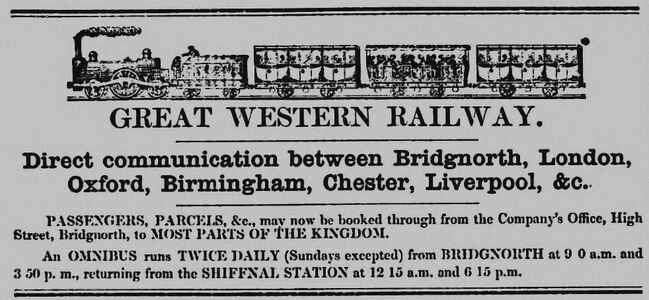 GWR advertisement (1856)

The SVR Company board meeting on 22nd May 1861 records him as requesting employment. He was taken on from January 1862 by the West Midland Railway as the first Station Master (paid £100 per year in August 1863). The Post Office Directory of 1863 records him plus Thomas Whitefoot as 'Parcels Agent' and also John Grant as Agent for the London and North Western Railway (LNWR) Goods Department in High Street. In this case, goods were taken to Madeley Market station but this arrangement didn't last as John Grant had been a Railway Clerk at Wednesfield in the 1861 census and was the Agent for Crowley's (cartage carriers for the LNWR) in Kidderminster by 1865. Frederick Lowe was the LNWR Agent in 1870.
William Doughty must have had a fiery temper as he was brought before the magistrates at Bridgnorth twice for striking passengers in his short time in charge. Firstly, on 3rd October 1863, he assaulted Mr Dutton for entering the platform without a ticket and refusing to leave – he was acquitted. At the end of August 1866, he was convicted of striking Schoolmaster Witherington at the station and fined £5. They were rival agents for the Accidental Insurance Company. The Schoolmaster was touting for business on the trains and Doughty asked him for a ticket which resulted in an argument and altercation. He resigned from his role shortly afterwards but lived on in Ambrose Cottage at the station where he took up farming although still acting as an insurance agent.
Isaac Norris Hunt[edit | edit source]

Doughty was succeeded in September 1866 by Isaac Norris Hunt, born 18th April 1828 at Clifton near Bristol. He was employed by the West Midland Railway from January 1861 becoming the first Station Master at Buildwas before transferring to Stourport in August 1863 where son Stanley was born. He served at Stourport until September 1866; his weekly wage was initially 20/6 but from January 1864 his annual salary was £80 and £90 two years later. He was promoted from Stourport on a salary of £120;[1] his time at Bridgnorth lasted only two and a half years before he became Goods Agent at Chester followed by Liverpool before retiring from Birkenhead on 4th February 1889.
Samuel Martin[edit | edit source]
Samuel Martin (born 13th April 1834 in Weymouth) took over from Hunt in January 1869 for a salary of £130 per year. It was his first such appointment having started his railway career in Birmingham in 1854 as a Passenger Clerk followed by 7 years at Weymouth and 4 years at Chester. His wife, Hannah, had passed away so he resided with the Taylor family at 66 Whitburn Street, Bridgnorth. In April 1872 he returned to the West Country to become Station Master at Westbury before retiring from Yeovil in 1899. According to local press articles he was hard working, looking after an excursion train of 24 carriages in July 1870 carrying 700 workers from the Patent Shaft Works at Wednesbury. Just one month later, he provided the entertainment on Tuesday evening 2nd August in connection with the Working Men’s Constitutional Association fete on Pan Pudding Hill. The 1870 Kelly’s Directory lists the South Wales and Cannock Chase Collieries Company (SW&CCC) as having set up a coal and coke depot at 'Railway Wharf' (below the coal drops?) with Agent Joseph Harry Ritson alongside Irwin and Sellers coal merchants. The former was to last until the Second World War but the latter was not referred to in the 1880s. Richard T Smith had been appointed as goods carriers from the station by the GWR.
James Alexander Masters[edit | edit source]
James Alexander Masters (born 3rd July 1840 at Witney in Oxfordshire) began work for the Oxford, Worcester and Wolverhampton Railway in May 1854 before its absorption into the West Midland Railway in 1860. He transferred to the GWR as Assistant Travelling Auditor at Worcester in August 1863.[1] His first Station Master's role was at Malvern Link in January 1864. He took over from Samuel Martin in April 1872 at a salary of £130,[1] but lost his wife soon afterwards before succumbing himself on 6th July 1873, aged only 33.
William Edward Bradshaw[edit | edit source]
William Edward Bradshaw took over from JA Masters but at a reduced salary of £110 per year. He was born in Sulgrave, Northamptonshire on 19th May 1841 where his father was County Police Superintendent. His railway career followed the moves of his father, starting as a Railway Clerk at Wrexham in 1861 before ten years as a Passenger Clerk in the West Midlands at Birmingham Snow Hill and Wolverhampton Low Level. He married his wife, Annie, in Wellington, Salop in 1868. He was only at Bridgnorth for two years until August 1875 when they moved to South Wales but his son, Reginald was born in Bridgnorth. His last post was as Assistant Superintendent at Tondu where he retired in 1910.
Frederick Conrad Barratt[edit | edit source]
The short spells in charge continued with Frederick Conrad Barratt. He came from Crewkerne in Somerset, born 14th September 1833. In July 1855 he was in South Wales employed by the West Midland Railway Company, marrying Isabella Brown in Pontypool in November 1855. His first Station Master appointment was at Penmaen (Tredegar Junction). Following a year at Ledbury from August 1863, he spent over ten years at Abergavenny living in the Station House. He became ill at the end of 1874 but was well enough to be moved to Bridgnorth in July 1875. His salary at Bridgnorth was £130.[1] He passed away on 13th November 1877 at Merthyr Cottage Abergavenny, as he had been replaced as Bridgnorth Station Master in September 1877.
William Ganniman Bowerman[edit | edit source]
Finally, some stability with the new appointment of William Ganniman Bowerman. Another native of Witney in Oxfordshire, born on 18th March 1836; his father was a Clerk in a waggon office so he began his career as a Clerk at Paddington Goods Office. His first Station Master appointment was at Aylesbury in March 1865. After further transfers he moved from Harbury to Bridgnorth in September 1877 for £110 per annum. He married Emma Ormerod at Bridgnorth in April 1882 but she died in January 1888. He lived at 45 West Castle Street with his sister as housekeeper before moving to 39 West Castle Street before retiring on 10th November 1896. In retirement, he lived at nearby 67 Oldbury Vale, before returning to Abingdon where he passed away on 18th February 1912.
During his 20 years in charge, there was quite an expansion of staff and facilities. Bridgnorth Town Council had aspirations from 1870 to make a better approach to the station as the existing one traversed a timber yard with danger to all users. Their surveyor had produced a scheme for an embankment across a field with a bridge over the lower road to New Road – costing £2,000 for a length of 100 yards. While the Corporation offered land and soil, the GWR declined to build it. At the Town Council meeting on 7th October 1875, the Surveyor reported that WO Foster of Apley Park had agreed to donate the land and he had developed a further option of a brick viaduct in lieu of the embankment at a cost of £3,500. In December 1879, the Committee of the Town Council were reporting the purchase of Yew Tree Cottage and taking space from others to aid the widening of the frontage on the George Hotel side but better access was yet to be provided. The Town Council in March 1887 considered options to provide a memorial for Queen Victoria's jubilee. – two of the options were the new road approach for £2,500 or a footbridge to the station for £850. After being turned down by the GWR following a visit in early May they decided to refurbish the Town Hall instead!
Meanwhile, the GWR carried out works in 1887 to raise and widen the platforms, erect a footbridge in between (replacing the foot crossing) and provide a larger waiting shelter. All was not lost with the roadway access as, in August 1891, GWR's Traffic Committee gave approval to the construction of a retaining wall and roadway to replace the old embankment with a coal siding and two signal boxes at a cost of £3,013. The construction took until September 1892 when the Board of Trade gave approval to the new signalling layout with an additional Signalman and two Signal Porters taken on. The Town Council decided to go ahead with the footbridge across to New Road in August 1894 having received no less than 13 tenders to the design of JEO Thompson of Warrington. The lowest tender for £1,010 was from Bradley and Lloyd of Shifnal with Rubery and Company of Victoria Ironworks, Darlaston providing the ironwork – the GWR agreed to contribute £95 for the west abutment. It was opened on 2nd June 1895. In the 1893 Working Time-table it was reported that a gong had been fitted in the entrance to the tunnel to aid shunting of the yard.
Approval was given to the enlargement of the Goods Office in October 1895 for £68 and a year late for the Station Master's office to be converted to a Third-class Ladies Room with the Porters Room becoming the Station Master’s Office for £39. In Kelly’s 1895 Directory we see the appearance of Eveson and Co as coal merchant at the station while JH Ritson was not only agent for the SW&CCC's depot but had set up as a coal and lime merchant himself at the station. JT Hudson was the agent for RT Smith. One of Bowerman's last acts was to oversee arrangements for the Shrewsbury and West Midlands Agricultural Show on grounds north of Bridgnorth tunnel in early 1896 where a special siding was laid down costing £228 re-charged by the GWR to the organisers.
John Samuel Collett[edit | edit source]
John Samuel Collett (born 3rd June 1858 at Chadlington Oxfordshire) was present at Bowerman's retirement do and took over the role living at 3 Victoria Road in a new villa. He had joined the GWR as a Clerk at Chipping Norton in 1871, transferring to Droitwich in 1875. His first Station Master role was at Leckhampton in 1881 before becoming a Relief Clerk in the District Superintendent's Office at Worcester in 1889. His pay at Bridgnorth was £150 per year. He married Elizabeth Charlton of Steeple Barton in Oxfordshire soon after starting at Bridgnorth. His term of nearly 10 years was cut short through ill health. He died on 13th August 1905 and is buried in St Leonards churchyard in Bridgnorth. During his time, there was an additional 47 wagon siding constructed for £3,330 (including land purchase) in 1901; the road motor service to Wolverhampton commenced in November 1904 with a shed for a road motor erected in early 1905 for £32 and the accommodation for cattle was expanded for £78.
William James Cowan[edit | edit source]
William James Cowan succeeded Collett in October 1905. He was born in Stonehouse, Devon, on 27th July 1857 starting with Devon and Cornwall Railway Company, before joining the GWR in the Superintendent’s Office at Plymouth in 1876. On his retirement, he claimed to have taken on the Station Master’s role at Helston in 1889 (the GWR record says 'Passenger Clerk'). He moved to Bridgnorth for £175 per annum from Parcels Superintendent at Plymouth Millbay but declined an invite to the mayor's banquet on arrival. He lived at 5 Victoria Road, Bridgnorth before returning to the West Country as Station Master at Newquay in November 1914. After retiring from there on 8th October 1921 he returned to Shropshire living at 20 Bridgnorth Road, Wenlock where he passed away in April 1945.
George Smith[edit | edit source]
Cowan was succeeded by George Smith in 1914. Another native of Oxfordshire, he was born on 14th January 1867 at Shipton under Wychwood. Initially a 'Railway Messenger' at Shipton, he became a Porter at Stourport in March 1882. The next ten years saw Passenger Clerk’s duties at Pershore and Great Malvern, returning to Chipping Norton to marry Alice Bertha Jones in 1892. His first role as Station Master was at Bewdley from September 1898 for 11 years, living in the Station House with Alice and two children. Before his time at Bridgnorth, he spent five years as Station Master at Chipping Norton, then came to live at 1 Oldbury Terrace, a short walk from the station - his pay was £170 per annum. One of his daughters, Edith, was taken on as a Goods Clerk. He retired in December 1928, passing away at Bridgnorth on 4th October 1931.
The 1920s saw more improvements to the layout. In 1921 the GWR Traffic Committee agreed to the construction of a siding and loop for Herbert Smith for £4,360 (became Knowlesands Brickworks in November 1924). A 54-lever central signal box was authorised in April 1922 for £3,361 with £200 being spent on the livestock accommodation the following year. Richard T Smith had been the cartage agent for the GWR at Bridgnorth from the early days but, following the death of Sir Richard Vasser-Smith in 1922, the business was bought back in-house – from January 1924 in Bridgnorth's case. The opening of the Sugar Beet Factory at Foley Park stimulated local farmers to plant the crop and the GWR’s Traffic Committee authorised the provision of a loading bank in the yard at Bridgnorth, costing £995 in June 1927. Finally, Bridgnorth was chosen locally for the launch of the GWR’s new Country Lorry Service from June 1928 with George Smith being given as the contact for more information.
Charles Thomas Tubey[edit | edit source]
To succeed George Smith, Charles Thomas Tubey (born 19th March 1883 in Slough) was moved from Malvern Link where he was Station Master living in the station house. He had joined the GWR as a Passenger Clerk at Kensington in 1897 transferring subsequently to other London suburban stations. Soon after marrying Mary Elizabeth Timber at Eton in July 1907, he was promoted to Chief Booking Clerk at Kidderminster in October 1909 where they lived at 110 Offmore Road – by 1916 he was paid £135 per year. In the mid- 1920s he was promoted to Station Master at Malvern Link. He only spent one year at Bridgnorth returning to Malvern Link in July 1930. However, within 3 years he had died at only 50 years of age.
David Benjamin Davis[edit | edit source]
In August 1930, David Benjamin Davis was appointed Station Master at Bridgnorth. He was born locally at Stourport on 10th September 1880; his father being a tinplate worker from Tredegar but his mother was from Birmingham. He commenced as a Passenger Clerk at Evesham in 1897 before moving to Bewdley in May 1899. After 14 months there, he was promoted to Bromyard, where he boarded locally. He married Mary Tarplett at Moreton in Marsh in July 1906 while he worked there. They moved to Ledbury for four years, before he became Goods Clerk at Bridgnorth. In 1918 he became Chief Goods Clerk at Bridgnorth for £130 per year living at 46 West Castle Street. His Station Master role began at Withington, Herefordshire in 1922 followed by Chipping Norton. In the 1934 Kelly’s Directory we see Eveson’s (agent J Downes) and SW&CCC (agent R Nicholas) continue with Hollybush Road as the address but the Anglo-American Oil Company had set up a depot in the yard as with other town yards in Shropshire. Davis retired from Bridgnorth in April 1940 when they resided at 2 Cliff Gardens. The only addition to the facilities in the Traffic Committee records is the construction of warehouse accommodation in 1937 for £215 by Edgeall Construction.
George Herbert Noble[edit | edit source]
George Herbert Noble was not transferred from Bromyard to Bridgnorth as Station Master until November 1940 so the Divisional Superintendent’s Office at Worcester would have made interim arrangements in the previous six months. He was born in Withington in Herefordshire on 11th September 1891 where his father Edwin was Station Master. He joined the GWR as a trainee Passenger Clerk at Ashperton on 6th May 1907. He had a varied career moving between stations in Herefordshire including spells at Kidderminster and Bewdley – in the 1921 census he was a Goods Clerk living in Spencer Avenue, Wribbenhall. His first appointment as Station Master was at Colwall in the 1920s. His wife, Gwendolin from Hereford, went to teach at St Leonards School at Bridgnorth. He was at Bridgnorth for 12 years before transferring to Stratford upon Avon in July 1952 followed by retirement in Wellington, Shropshire where he passed away on 4th February 1988. Interestingly, the Traffic Committee gave approval on 23rd March 1947 to the purchase of 4 Westgate, Bridgnorth from the executors of Ms E Haynes for £1,750 for staff use(?). The private siding agreement for Knowlesands Brickworks was terminated on 16th September 1948 and the sidings taken out of use in September 1951. Eardington came under the control of the Bridgnorth Station Master from 1949 and Hampton Loade from 1st April 1951.
William Leslie Mann[edit | edit source]
Noble was succeeded by William Leslie Mann, a native of Llantarnam in Monmouthshire, born on 11th September 1904. His father John was Station Master there and they lived in the Station House. He joined the GWR as a Goods Clerk at Llantarnam in 1919. He married Ethel Emily Gresham from Bridgnorth in Heywood, Lancashire in January 1935 and became Chief Goods Clerk at Bridgnorth in 1938 where they resided in 4 Victoria Road. His first Station Master appointment was at Broadway in 1944 moving to Bridgnorth in July 1952 from Charlbury. During his time at Bridgnorth the station featured in an article by reporter Terry Bond in the Bridgnorth Journal on Friday 25th January 1957. The Journal also reported on 2nd November 1956 that for the third year in succession Bridgnorth Station had won the prize for the best hanging baskets in Worcester District’s competition. He also welcomed the Duchess of Kent to the town station on 28th May 1957 when the station was well decorated. Two sectional concrete buildings were erected in the yard in the 1950s – one for cattle feed for Bibby and Company.
Arthur Gordon Ray[edit | edit source]
Arthur Gordon Ray was transferred from Bewdley in August 1960 to take charge of Bridgnorth, ending up as the last Station Master in November 1963 to join the Goods Department at Hereford (goods services at Bridgnorth were withdrawn from 2nd December). He was born in Llantrisant on 14th March 1909 where his father was a blacksmith. However, both his parents originated from Shropshire. His railway career began with the GWR at Llantrisant as a Railway Clerk before transferring to Bridgend where he was to marry Mary Elizabeth Crowley in May 1935. He moved to the District Superintendent’s Office at Gloucester in June 1948 before his first Station Master appointment at Nine Mile Point in the early 1950s. From December 1954 he was a Relief Station Master in the Cardiff Superintendent’s Office before a fixed appointment at Bewdley in October 1956. He featured in the Western Region Rail News ‘Spotlight on Bewdley’ in January 1962. The last employee to leave Bridgnorth Station was fittingly Alderman Charles Hathaway (Mayor of Bridgnorth) employed there for 47 years. He departed on 1st February 1964 although Elias Thorpe continued his lease of the refreshment room until the preservation era, having taken it out in 1952.
Traffic statistics in commercial service includes information on the traffic receipts for Bridgnorth from 1903 to 1952 in ten-yearly intervals. The 1943 and 1952 details do not show total goods receipts nor the amount of cartage but do record the numbers of invoices processed – around 100 per day. There also seems to be a change in passenger ticket receipts showing a large drop in income per ticket for those years – the closure of the airmen training base (complimentary tickets?) at Bridgnorth may have impacted on this. The staff numbers are remarkedly consistent and the breakdown of roles are shown below the table for 1922 and 1934 where the information survives in the National Archives. There is little doubt that Bridgnorth Station made a positive contribution to the profitability of the railway and the town in its 100 years.
See also[edit | edit source]
References[edit | edit source]
Article prepared by Chris Haynes, using sources:
- Great Western Railway (GWR) staffing records in the National Archives
- Census records on Ancestry UK
- British Newspaper Archive