The development of Kidderminster Town Station

This page gives a history of the creation of the SVR's Kidderminster Town Station on the site of the former BR goods yard during the 1980s, and major developments since that time.
The three pictures below were taken from Kidderminster Footbridge and show how the station site has changed over time. The first shows the goods yard before constuction of the SVR station began, the second after construction was completed, and the third after the island platform was extended in 2025-26.
-
 Kidderminster Goods Yard, February 1984
 -
 The same view in 2009
 -
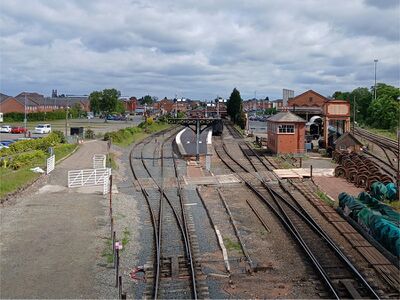 The same view in 2026

_-_geograph.org.uk_-_1553544.jpg)

Before Opening day[edit | edit source]
Kidderminster goods yard closed on Saturday 14 May 1983, allowing negotiations with BR for the extension into Kidderminster to begin. The SVR would buy the one mile of track from Foley Park to Kidderminster Junction for £75,000, with the remaining quarter mile of track and around 3 acres of land in the former goods yard leased at an annual cost of £14,000.[1]
-
 Kidderminster Goods Yard, September 1983

While fund raising through a share issue was under way, work went ahead on producing a design for the station. This was carried out by Bob Marrows, an SVR member and qualified architect. The station building was to be based on an 1890 design for Ross-on-Wye by JE Danks of the GWR Civil Engineers Department.[2] Within the station, an island platform was planned to accommodate a 10-coach train on one side and an 8-coach train on the other, both with run round loops. The proposed track plan by Steve Scott shown below was originally published in SVR News in Summer 1984.[3][note 1]
-
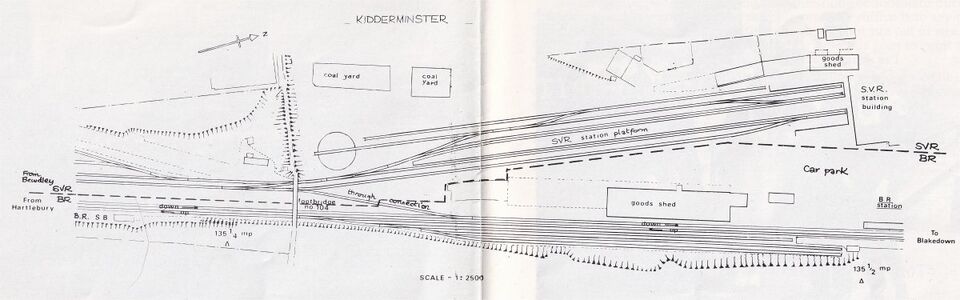 1984 proposed track plan (Steve Scott / SVR News)

February 1984:
- The SVR applied for the Light Railway Order (LRO) necessary to operate over the last section of the line between Foley Park and Kidderminster. Even though they would now own the line, without an LRO they could not use it without a hired-in BR driver. This made it more difficult and costly to move materials to Kidderminster from elsewhere on the line.
- BR allowed certain preparatory works to take place, including lifting the old sidings, points and stop blocks ready for construction of the new platforms. These materials were piled up for later sorting and re-use.
-

-
Kidderminster Goods Yard, February 1984

March 1984: The SVR site was temporarily fenced off from the BR lines, a BR flagman standing duty on the main line while this work was carried out.
April 1984: BR allowed temporary adjustments to the layout in advance of proposed engine movements. The existing SVR line into the BR down goods loop was slewed into the former second siding, allowing SVR trains direct access to the goods yard. There were still three other connections to BR at various points, only one of which would be retained.
May to July 1984:
- Work began in earnest with BR granting “walking permits” for workers on the site. The proposed opening date of 30 July gave just eleven weeks to complete the job. Construction of the platforms took place, although the available funding was limited and these were built shorter than the original plan.[4] Concrete sleepers were brought in by rail from Bewdley on 11 May using D1013 Western Ranger crewed by BR men, and the section from the former second siding to the Hoo Road Bridge was relaid in the first week. All other trackwork between the new running line and BR was recovered, including the two redundant connections. New drains were dug and new ballast laid, so that new tracks and points could be installed. New signalling equipment was also installed.
-
 May 1984, 2 months from opening

- In the rush to achieve the planned opening dates, a number of mistakes were made. The materials lifted during the preparatory work in February were dumped on what became the new alignment of the line, and some time was lost moving them. An error in dimensions led to the platform height being several inches too short, so wooden sleepers were installed between the platforms not for authenticity but because they were shorter in depth than the concrete sleepers purchased for the job. Late in the day the platform road had to be slewed by 2” due to an out-of-date ex-LNWR gauge having been used when it was first laid.
- Granting of the Light Railway Order late in the day finally allowed the SVR to use the line in the last week of construction; tasks still to be completed at that stage included installation of the dock platform road, lifting packing and slewing the run-round loop and replacing the BR/SVR boundary trap points at Foley Park with plain track. However the line was passed fit by the Railway Inspectorate, and the opening day deadline was met.
- Most of the work involved was carried out by the SVR’s P.W. Department, and P.W. Loco drivers and firemen were given the honour of crewing the inaugural services.
Opening Day[edit | edit source]

The opening day was summarised thus in the first paragraph of the General Manger’s Notes, SVR News Issue 73:
- “So we did it, didn’t we! 30th July saw the opening to the public of the Kidderminster Extension, and if ever there was a close run thing on the SVR, this was it. When I tell you that the Light Railway Order did not become operational until 00.01 hours on Saturday morning, 21st July, and that the Line Inspection by Major P.M. Olver of the Railway Inspectorate did not take place until Tuesday Morning, 24th July, you can see how little margin was left for a last minute deferment of the public services. But all went well, Major Olver gave us a detailed inspection and we passed with flying colours, so enabling a further last minute effort to be made prior to the ‘Kidderminster Venturer’ leaving our new terminus slightly behind schedule at 12.30pm. “So ends the beginning”, and without the total support of our members and shareholders, we would not have been able to achieve the objective which was but a gleam in the eye of the group of local railway enthusiasts who held that famous first meeting in July, 1965 at the ‘Coopers Arms’ in Kidderminster. It was a shame that the originator of the SVR, Keith Beddoes, was unable to be among the invited guests on opening day. The late Sir Gerald Nabarro was always totally firm in his opinion that our Railway would reach Kidderminster, and his dream as identified in the first public Prospectus which we issued in April, 1972 was to see a new station arising from the present one at Kidderminster bearing the legend once displayed at Hartlebury ‘CHANGE HERE FOR THE SEVERN VALLEY LINE’. I feel that we have achieved that objective which was eventually shared by just about every single member and shareholder of the SVR and perhaps the most moving and heart-warming comments to be made on the day were from those of our long-standing members who said that this had been the happiest day on the Railway since we ran our first public service in May, 1970. Those words were part of a day which will live in the memory of those of us who were privileged to attend.”
Two of the SVR’s flagship locomotives took pride of place. 4930 Hagley Hall hauled the inaugural 12:30 ‘Kidderminster Venturer’ to Bridgnorth, appropriately consisting of 9 coaches of GWR stock referred to above. Twenty minutes later the inaugural service from Bridgorth ‘The Kidderminster Envoy’ arrived behind 45690 Leander to the sound of exploding detonators which had been placed on the line. British Railways ran a special DMU service from Birmingham New St. carrying a large ‘Severn Valley Railway’ board.
Developments since[edit | edit source]
After opening, the Railway was initially restricted to 'one engine in steam' on the Kidderminster extension. During the summer of 1984 facilities at Kidderminster were primitive; the booking office was converted coach GWR 98 Full Brake, catering and toilets were temporary structures and the gift shop was likely to blow away in a gale. But already the new station building was under way, funded by the 1983 share offer. Phase 1, the West wing now housing the gift shop, opened in time for the 1984 Santa Special services to run from Kidderminster. Phase 2, including the station front, was built the following summer. The first watering facilities were also commissioned during 1985.
Pointwork around the station was initially controlled by the 6-lever Kidderminster ground frame, released by the Bewdley South--Kidderminster staff. The current Kidderminster signal box was commissioned on 21 November 1987.
-
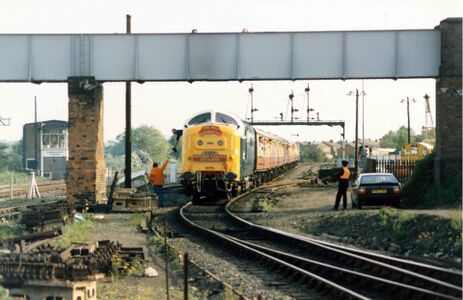 Early signalling arrangements at Kidderminster, with the ground frame visible to the left, adjacent to the bridge pillar (M. Gibbons)

Platform 2 was brought into use on Sunday 25 November 1990, with 7819 Hinton Manor making the first operational entry into it.[5]
From time-to-time further cosmetic additions were made to the station; these include a number of projects sponsored by the Friends of Kidderminster Town Station such as the Port Cochere style canopy at front of the building and the ornamental roof crestings. The pattern for these cast roof crestings were copied at the SVR's pattern shop from fragments of originals recovered from Ross-on-Wye.
Completion of the station building (2006)
Phase 3 of the station building, the construction of the East wing (also known as The John Garth Building) began in February 2006 and was opened by HRH The Duke of Gloucester on 18 October 2006. It mainly houses the station's licensed restaurant and buffet, and the multiple award-winning King & Castle pub. The concourse roof was also installed at the same time. This development was funded by a £550,000 loan ('Loan 1' in the SVR(H) accounts) drawn down in April 2006 and payable over 20 years. From 2008 the Company increased its monthly repayments, and the loan was paid off in 2020.[6](Pictures from Wikimedia Commons)
-
 February 2006, preparations for Phase 3
 -
 February 2006, installation of new canopy


Platform extension (2025-26)
In 2025, following recommendations from the Office of Road and Rail (ORR), a project began to extend the existing platform to the length originally planned in the 1980s. This would take place in two main phases. The first phase saw the installation of a new starting signal bracket for both platforms, replacing the separate "temporary" signals installed in the 1980s. The second phase involved various works including realignment of the track into platform two and the run round to accommodate the longer platform, and the relocation of the vehicle crossing adjacent to the signal box.
Some of the milestones in the project were:
- Over the winter of 2024-25, excavating the siding area at Foley Park provided a large quantity of fill material "suitable for a future platform extension at Kidderminster".[7] The signalling location cabinet 'LOC 60' was also moved from its position adjacent to the track boundary fence to a new central site between the running lines.[8]
- Some years ago, the SVR had acquired a large bracket signal from Radyr Junction with the assistance of the SVRA South East Branch. By May 2025 work had started on refurbishing it.[8][9]
-
 Radyr Junction bracket signal (1990)

- The bracket was installed and the Platform 1 signal commissioned in time for the September 2025 Autumn Steam Gala. However the Platform 2 signal could not be commissioned until after the points for platform two were moved as part project. At that time, the project team was still developing the design.[4]
- Between October and Christmas, work began on the second phase. The track and crossing were moved to their new positions, and preparation work for the platform foundations began, with shuttering and reinforcing being installed ready for concrete to be delivered. After the foundations were installed, the work was paused whilst Christmas services operate, followed by the Winter Diesel Day and Steam Gala.[10]
- Work resumed in January with Walsh, the contractor, completing the blockwork and concrete infill.[11] The project was then paused due to a delay in the manufacturer producing the bespoke concrete capping blocks and then the requirement for two platforms to be in operation during the Spring Steam Gala and Easter running.[12] The construction work was completed with a formal opening ceremony taking place on 7 May.
-
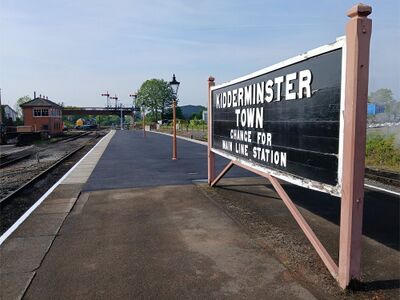 The new platform extension (May 2026)
 -
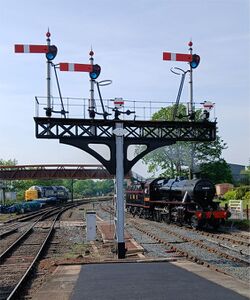 The new ex-Radyr bracket signal (May 2026)


Future plans for the platform include a canopy along the platform length similar to that at Bewdley.[13] On 3 June 2026 the Charitable Trust launched a 'Raise the Roof' campaign to help secure £1,000,000 to build the canopy. (external link) By August 2026 the appeal had passed £250,000.[14]
See also[edit | edit source]
Notes[edit | edit source]
- ↑ Descriptions of the platform's exact specification varies. Marshall states "10-coach and 6-coach"; recent articles by Gus Dunster in Branch Lines refer to "nine-coach trains". A notable feature of the original plan is the proposed location for a turntable in the coal yard area; this was eventually built the other side of Kidderminster Footbridge.
References[edit | edit source]
- ↑ Marshall (1989) p. 192.
- ↑ Marshall (1989) p. 192.
- ↑ SVR News 72, p. 20
- ↑ 4.0 4.1 Branch Lines, September 2025
- ↑ SVR News 108
- ↑ SVR(H) Financial Statements ending 5 January 2020 and 3 January 2021
- ↑ Branch Lines, February 2025
- ↑ 8.0 8.1 SVR News 229, Signalling Notes, p.52.
- ↑ Branch Lines, May 2025
- ↑ Branch Lines, November 2025
- ↑ [https://www.svrlive.com/blfeb26 Branch Lines, February 2026
- ↑ Branch Lines, March 2026
- ↑ SVR Website, news item
- ↑ Branch Lines, August 2026