Steam Railmotors at Kidderminster
This article considers GWR Steam Railmotors and their use in the area around the Severn Valley Branch.

Introduction[edit | edit source]
A 'Railmotor' was perceived as a self-propelled single carriage passenger train which could be driven from either end. The advantage over the conventional engine and carriage(s) were that they could be reversed easily and quickly with the added benefit of serving local stops with tickets being issued on board. It was an economical way of providing local trains in areas with clusters of towns close together where the traffic justified higher frequencies of service. The construction of Railmotors on the Great Western Railway (GWR) was a response to dissatisfaction with infrequent local train services and the arrival of competition from road transport. The Tramways Act of 1870 and the Light Railways Act of 1896 had stimulated new proposals for lines including the introduction of electric tramways. An additional feature of the new services was the provision of wayside 'haltes' (French spelling) with limited facilities to attract additional custom at a low initial cost.
Following trials of a borrowed steam railcar lent by the London and South-Western Railway, the GWR's General Manager, Sir Joseph Wilkinson, recommended to the Traffic Committee on 29th April 1903 that 2 Steam Railmotors (SRM) to a design by GJ Churchward should be built at an estimated cost of £2,500 each. The cars would be 59 feet 6 inches long, carry 52 passengers at 30mph and weigh 34 tons 10 cwt. The Stroud Valley was the chosen operation due to the success of the parallel road motor bus service with fares attractive when compared with the local trains where only 6 services operated daily. Additional platforms would be opened adjacent to the many level crossings (supervised by a gate keeper) and an hourly service would be run, which was too much to be covered by one car. It commenced on 12th October 1903 and was an instant success, 'blowing away' the road competition. 12,000 passengers were carried in the first week (compares to only 1,400 on the previous week's rail operation) with an average loading of 77 passengers – for the 52 seats!
At the Traffic Committee meeting on 2nd December 1903 the General Manager recommended that similar services might be established at places such as Plymouth, Newton Abbot and Worcester (to Malvern Wells) which required an additional 12 cars (of lighter build) with a further 12 SRMs ordered in February 1904. In the cases of cars 3 to 38, the first batch were built without a luggage compartment (similar to Nos 1 and 2), known as 'suburban' cars, while the second batch were so fitted and known as 'branch' cars. A further 30 cars were ordered in May 1904 and an additional 30 in October 1904 plus 20 trailers for attaching when traffic demanded it. These were auto fitted for driving at the one end with linked coupling. The orders were split between the suburban and branch types with the latter predominating. On completion of the building programme in February 1908, the Great Western had 99 cars in service. These numbers were supplemented by an additional 13 engines to act as spares. 14 engines were supplied by Kerr, Stuart and Co and 6 by Wolverhampton Works with the remainder by Swindon Works. 14 coach bodies were supplied by Kerr, Stuart and Co, 8 by the Gloucester Carriage and Wagon Co and the remainder by Swindon Works.
The Town Councils of Bewdley and Stourport were critical of the limited rail service to Kidderminster run by the GWR at the turn of the century. They had supported proposals for an electric tramway between Kidderminster and Stourport and also between Kidderminster and Bewdley. Powers were obtained for both lines by the British Electric Traction Company in 1896 and 1901 respectively. The former opened in 1898 from Comberton Hill (then known as Station Hill) outside the railway station to the river bridge at Stourport but the latter powers were allowed to lapse, probably influenced by the extra roadworks required by Worcestershire County Council. The tramway was quite successful and the railway service lost patronage – railmotors provided an ability for the GWR to fight back. A trial was run on the Bewdley – Hartlebury - Kidderminster triangle on 29th December 1904 which proved that an enhanced timetable was practical.
Commencing on Monday 2nd January 1905, a Steam Railmotor service began on the triangle between Kidderminster, Bewdley and Hartlebury with Foley Park Halte opened adjacent to the Stourport Road bridge at the same time. Rifle Range Halte opened on 12th April 1905 but did not appear in the public timetable as it sought to serve the local military training on the range.
-
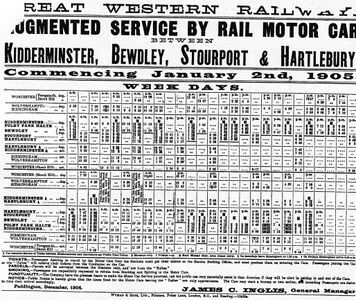 1905 timetable

The initial time table is shown, with motorcar services labelled 'M'. Note that there was guidance to passengers using the car services on obtaining tickets, on not smoking and spitting and no parcel conveyance from the Halte. At this stage, only one car was needed. The Traffic Committee authorised the appointment of 2 additional conductors and a porter from Kidderminster with the car(s) based there. The receipts for the 4 weeks ending on 30th April 1905 can be summarised as:
| Car tickets | Receipts (1905) | Mileage of car | Pass/Car Mile | Receipts (1904) | Increase |
|---|---|---|---|---|---|
| 10,912 | £125 3s 3d | 2,971 | 10.11d | £84 19s 8d | £101 19s 10d |
Note the increase includes the ordinary services which continued while the 1905 figure was for cars only. By September 1905, two cars were needed to run an enhanced service and limited facilities provided at Kidderminster shed.
Railmotor Design[edit | edit source]
A GWR Steam Railmotor consisted of three main components, each numbered in a separate series:
- The carriage including the underframe, coach body and trailing bogie were numbered 1 to 99 in the Railmotor series – each car was commonly known by this number. Key features of the coach bodies were the fitting of tall elliptical profile roofs (quite different to the contemporary clerestory stock) and bow ends; match boarding below the waist on the first 26 cars but traditional wood panelling finished in polished oak thereafter; open saloons with longitudinal benches and side bays plus motor compartment and driver's vestibule (luggage compartments provided for branch cars) and steps for alighting at halts with straps for standing passengers. They were gas lit with gas tanks supplied on the undercarriage.
- The engine or power bogie including the cylinders, motion, driving wheels and bogie frame with pipework. There were 112 of these – a third with 3 ft 6 1/2 in wheels, the rest with 4 ft diameter wheels. They used 12x16 inch outside cylinders with Walschaerts valve gear. A 450 gallons water tank was carried on the carriage underframe and there was a 15cwt capacity coal bunker.
- The vertical boiler was attached to the top of the frames by curved angle irons bolted on each side of the shell. There were 120 made for the 99 cars. They were 9 foot 6 inches high with the central chimney protruding through the cab roof. Most boilers were interchangeable but had to be removed by lifting out by crane clear of the body – a task unable to be carried out at Kidderminster shed.
In April 1905, GJ Churchward (Chief Locomotive and Carriage Superintendent) and J Morris (Superintendent of the Line) issued 'General Instructions to be observed in connection with Rail Motor Cars'. The role of 'Conductor' would be to act as guards (where a trailer car or carriage was attached a second conductor was encouraged), and as ticket issuer or collector at Halts. On approaching stations or halts, a clear and distinct voice must announce the names. They were also to operate moveable or retractable steps where provided. The conductors were to be paid 20s to 23s per week (passenger guards received 23s). Enginemen were paid 5s 6d per day on branches with an extra 6d when working on a main line. Firemen received 3s and 3s 6d respectively.
SRMs in Service[edit | edit source]
There were quite a few problems in service from the outset. The Superintendent's meetings were provided with a list showing each failure and its cause. The record from September 1906 to December 1907 exists and the Kidderminster Car failures are listed below, together with incidents recorded in the GWR staffing records on 'Ancestry UK'. A number of actions are recorded to help lessen the failures resulting from the short wheelbase, the high centre of gravity of the boiler, the small diameter of the driving wheels and the cylinders working loose on the frames caused by the racking action. Later cars saw the driving wheels diameter increased, while additional strengthening was applied to the boiler and cylinders.
| Steam Rail Motor Incidents with Kidderminster Cars | |||||
|---|---|---|---|---|---|
| Date | Location | Car No | Servant | Description | Consequence |
| 12/09/1905 | Bewdley Tunnel | Joseph Gould 38 | Car ran into cow in tunnel, killing it | Disregarded block regulation 12a | |
| 10/11/1905 | Stourport | 27 | James Body 28 | Put hand through end window glass | Cut but continued at work |
| 17/01/1906 | Kidderminster | Arthur William Cooper 29 | Leaving shed, moveable steps hit ground disc | Steps damaged - Cautioned | |
| 28/01/1906 | Foley Park Halt | Francis John Smith 33 | Omitting to stop car as booked (lamps not lit) | Promotion deferred 2 months | |
| 05/02/1906 | Stourport | 37 | Sidney Ernest Hughes 21 | Sprained ankle jumping off car to pick up waste | Returned to duty 9/02/1906 |
| 26/12/1906 | Kidderminster | Albert Davies 33 (Pilotman) | Not prepared to work car when sent ex Worcester | Promotion deferred 1 month | |
| 07/01/1907 | Kidderminster | Thomas William Jennings 24 | Appointed Motor Fireman 4/- per week (was Shunt Fireman) | There until 23/12/2010 | |
| 08/01/1907 | Kidderminster | George Henry Herbert 24 | Appointed Motor Fireman 4/- per week (was Shunt Fireman) | There until 05/09/1910 | |
| 14/01/1907 | Kidderminster | James Henry Betteridge 24 | Appointed Motor Fireman 4/- per week (was Shunt Fireman) | There until 02/03/1912 | |
| 28/05/1907 | Hartlebury | 29 | William Dennant Turner 29 | Went to look out of side window, putting arm through glass | Cut arm but continued to work |
| 14/03/1908 | Kidderminster | Thomas Davies 28 | Putting car away but hit empty coaches causing damage | Cautioned | |
| 15/09/1910 | Foley Park Halt | 37 | Benjamin Price 23 | Working reversing lever when slipped and sprained knee | Continued at work |
| 03/01/1911 | Kidderminster | Gas Fitter Cartwright | Knocked down by Railmotor in yard at 2.30pm | ||
| 06/04/1911 | Bridgnorth | 77 | Thomas William Field 41 | Approaching carriage with car when skidded breaking buffer | Piece thru car window cut thumb |
| 26/08/1911 | Kidderminster | Frederick Thomas Davis 27 | De-railed third 1210 when moving with car over points not set | Resigned - emigrated to India | |
| 01/09/1911 | Kidderminster | Car Conductor Binnersley | Fell over ballast onto rails at 10.50pm | ||
| 17/07/1912 | Bewdley | 66 | Thomas William Field 42 | Ran out of water resulting in injectors not working | Car failed - cautioned |
| 06/09/1913 | Kidderminster | Car Controller Watkins | Finger pinched in door of car at 6.57pm | ||
| 22/09/1913 | Kidderminster | 96 | Ernest Ferebee 21 | Alighting from car on wet footboard, slipped and caught hand rail | Sprained left side/ bruised ribs |
| 27/03/1914 | Bridgnorth | Trespasser Fowkes | Fell off back of Rail Motor Car at 6.20pm | ||
| 15/06/1915 | Kidderminster | 92 | Thomas William Field 45 | Making a trimming for Car when copper wire went into thumb top | Injured |
| 11/01/1917 | Kidderminster | 71 | Howard Frances Taylor 24 | Poking fire when pricker slipped and struck his groin | Off until 26/03/1917 |
| Steam Rail Motor Failures September 1906 to December 1907 - Kidderminster Cars | |||||
|---|---|---|---|---|---|
| Date | Location | Car No | Service | Fault | Delay |
| 03/09/1906 | Kidderminster | 54 | Leaking tubes | 0 minutes | |
| 12/11/1906 | Worcester | 54 | Kidderminster service | Valve blown out | 0 minutes |
| 02/12/1906 | Kidderminster | 37 | Approaching Churchill | Brake pull rod uncoupled | 11 minutes |
| 09/01/1907 | Kidderminster | 64 | Steam pipe broken | 0 minutes | |
| 12/01/1907 | Worcester | 54 | Kidderminster service | Boiler buffing spring broken | 0 minutes |
| 13/02/1907 | Bewdley | 54 | Short of steam | 81 minutes | |
| 01/07/1907 | Kidderminster | 73 | 10.42am off Kidderminster | Tubes leaking | 0 minutes |
| 15/07/1907 | Kidderminster | 71 | 1.23pm off Kidderminster | Injectors failed | 0 minutes |
| 24/07/1907 | Easton Court | 29 | 3.45pm off Kidderminster | Brake rod broken | 5 minutes |
The SRMs were, initially, very successful commercially, such that passenger capacity became a problem resulting in the main batches being 70 ft long cars rather than the 59ft 6 in cars first built. Although this increased seating from 49 to 61 and expanded luggage space, the extra length between bogies could be a problem around tight curves (less than 6 chains) requiring slacking of coupling between car and trailer. The haulage capacity was generally limited to one extra vehicle where any gradient steeper than 1 in 100 was involved. Another disadvantage was the servicing of the power unit taking place in the engine shed, the single road wooden shed behind Kidderminster up platform being a quite basic affair. Any serious maintenance meant the whole car was out of use with passenger accommodation being difficult to keep clean. The boiler removal required crane capacity at Worcester, Wolverhampton or Swindon.
The low water and coal capacity needed vigilance for the fireman with topping up of water after around 25 miles and 140 miles for coal. The diagrams in Appendix 3 show pauses at Kidderminster, in particular, for such attention during the day. Walter Cotham (fireman at Stourbridge) recalled that it was fatal for steam production to open the firehole door when the regulator was open (problem caused by the door being immediately below the boiler tubeplate which would result in cold air going vertically up the tubes). Therefore, there was usually frantic activity to recharge the firebox at stops. There were quite a few changes in livery with the early cars in fully lined brown and cream. Between 1908 and 1912 the livery was changed to lined brown (there were complaints about the deterioration of the cream finish above the waist). After 1912 until 1922 lined lake was the norm, reverting to lined brown and cream after 1922.
The Worcester Division's first allocation was to Evesham for a service between Honeybourne and Stratford-upon-Avon and along the newly opened line to Winchcombe towards Cheltenham. Halts were opened in October 1904. The Kidderminster Car No 35, was initially recorded as allocated to Wolverhampton Division before switching to Worcester, which was closer. It was recorded in July 1905 as starting at 6.15am, working 16 hours per day, averaging 142 miles with a maximum speed of 26mph and an average between stops of 22mph, while pulling one carriage. The coal consumption averaged 18.45Ibs/mile which meant that the Kidderminster car coal bunker required topping up at least once during each day. Of the cars which served at Kidderminster, the shorter cars of 59 ft 6in length (Diagrams G, H and J with match-boarding below the waist), featured, but soon the 70ft cars of Diagrams K and O with wood panelling predominated. The final diagram R cars were first seen in Spring 1908 but were never dominant.
-
 GWR Postcard showing Steam Railmotor 54 at Bewdley circa 1905
 -
 A GWR Steam Railmotor at Bewdley circa 1908-1911
 -
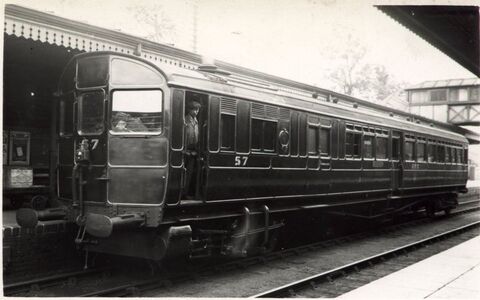 Railmotor 57 saw regular use at Kidderminster


One third of all Railmotors saw some service at Kidderminster, although six of these stayed for less than three months, usually replacing a car away at Swindon or Stafford Road Works. Most cars stayed for a year. The allocation records in the National Archives are extensive but not complete. The Stoppages Register gives details of Works visits based on the usual nomenclature of Light, General, Heavy and Boiler Change with days stopped also recorded. A visit to Swindon Stock Shed indicates time awaiting Works or awaiting a new shed allocation. The table below records the times at Kidderminster for the longest serving SRMs and reveals the regular need for boiler changes. Note that the cars allocated to Worcester were used as spare for the Kidderminster services.
| Longer Serving Kidderminster Steam Railmotors | |||||
|---|---|---|---|---|---|
| Date | Allocation | Mileage | Repair | Days stopped | Comment |
| Car No 37 (Diagram K, Lot 1078, built Swindon, 45 Tons, cost £1,860) | |||||
| 27/02/1905 | Stourbridge (new) | 70 feet wood-panelled | |||
| 01/10/1905 | Kidderminster | ||||
| 02/12/1905 | Stourbridge | ||||
| 19/12/1905 | Stafford Road Works | 20981 | General/Boiler Change | 55 | |
| 26/01/1906 | Kidderminster | ||||
| 17/10/1906 | Stafford Road Works | 42752 | Genral/Boiler Change | 44 | |
| 30/11/1906 | Kidderminster | ||||
| 03/04/1907 | Swindon Works | 50562 | General/Boiler Change | 73 | |
| 15/06/1907 | Goodwick? | ||||
| 01/05/2010 | Worcester/Kidderminster | ||||
| 06/03/2011 | Swindon Works | 149207 | General/Boiler Change | 43 | |
| 01/06/1915 | Kidderminster/Worcester | ||||
| 03/04/1919 | Swindon Works | 318205 | Heavy/Boiler Change | 205 | |
| 28/10/1919 | Bristol | ||||
| 19/10/1935 | Condemned | 513052 | Broken up | ||
| Car No 54 (Diagram O Lot 1088, built Swindon, 45 tons, cost £1,902) | |||||
| 20/09/1905 | Kidderminster (new) | 70 feet branch type | |||
| 23/02/1906 | Stafford Road Works | 13170 | Light/Boiler Change | 20 | |
| 15/03/1906 | Kidderminster | ||||
| 17/09/1906 | Stafford Road Works | 30475 | General/Boiler Change | 25 | |
| 12/10/1906 | Kidderminster | ||||
| 03/04/1907 | Swindon Works | 48788 | ?/Boiler Change | 64 | |
| 06/06/1907 | Kidderminster | ||||
| 04/11/1907 | Swindon Works | ? | ? | 26 | |
| 30/11/1907 | Kidderminster | ||||
| 11/04/1908 | Swindon Works | 60263 | Boiler Change | 20 | |
| 01/05/1908 | Swindon Stock Shed | ||||
| 14/10/1909 | Kidderminster/Worcester | ||||
| 10/12/1910 | Swindon Works | 128844 | Boiler Change | 31 | |
| 10/01/1911 | Merthyr | ||||
| 23/07/1929 | Swindon Works | 415980 | Converted to Diag A26 | Became Trailer 181 | |
| Car No 57 (Diagram O Lot 1088, built Swindon, 45 Tons, cost £1,902) | |||||
| 30/09/1905 | Weymouth (new) | 70 feet branch type | |||
| 01/01/1909 | Worcester/Kidderminster | ||||
| 06/08/1909 | Swindon Works | 97849 | General/Boiler Change | 74 | |
| 19/10/1909 | Swindon Stock Shed | ||||
| 22/11/1909 | Swindon Works | 98757 | General/Boiler Change | 75 | |
| 05/02/1910 | Swindon Stock Shed | To Merthyr in March | |||
| 01/03/1912 | Worcester/Kidderminster | ||||
| 06/05/1912 | Swindon Works | 163356 | General/Boiler Change | 72 | |
| 18/07/1912 | Monmouth | ||||
| 04/12/1913 | Worcester/Kidderminster | ||||
| 27/07/1914 | Swindon Works | 221388 | Heavy/Boiler Change | 57 | |
| 14/09/1914 | Kidderminster/Worcester | ||||
| 16/02/1915 | Worcester Works | ? | Light | 8 | |
| 24/02/1915 | Worcester/Kidderminster | ||||
| 07/10/1915 | Swindon Works | 262938 | Heavy/Boiler Change | 755 | |
| 31/10/1917 | Swindon Stock Shed | To Taunton 22nd Nov | |||
| 01/11/1927 | Swindon Works | 384115 | Converted to Diag A26 | Became Trailer 149 | |
| Car No 64 (Diagram O Lot 1100, built Kerr Stewart & Hurst Nielsen, 45 Tons, cost £2,743) | |||||
| 01/04/1906 | Kidderminster (new) | 70 feet branch type | |||
| 18/08/1906 | Swindon Works | ? | Light | 18 | |
| 05/09/1906 | Kidderminster | ||||
| 16/02/1907 | Swindon Works | 24786 | General/Boiler Change | 69 | |
| 26/04/1907 | Kidderminster | ||||
| 14/11/1907 | Swindon Works | 47659 | General/Boiler Change | 33 | |
| 17/12/1907 | Kidderminster | ||||
| 10/06/1908 | Swindon Works | 65394 | General/Boiler Change | 52 | |
| 01/08/1908 | Swindon Stock Shed | ||||
| 06/08/1908 | Stourbridge | ||||
| 09/02/1935 | Stourbridge - condemned | 452124 | Converted to Diag A29 | Became Trailer 216 | |
| Car No 66 (Diagram O Lot 1100, built by Kerr Stewart & Hurst Nielsen, 45 Tons, cost £2,743) | |||||
| 01/05/1906 | Croes Newydd (new) | 70 feet branch type | |||
| 11/11/1910 | Stratford on Avon | ||||
| 01/12/1910 | Kidderminster | ||||
| 11/02/1911 | Worcester Works | ? | Boiler Change | 12 | |
| 23/02/1911 | Kidderminster | ||||
| 10/07/1911 | Worcester Works | ? | ? | 14 | |
| 24/07/1911 | Kidderminster | ||||
| 09/12/1911 | Swindon Works | 144942 | General/Boiler Change | 115 | |
| 02/04/1912 | Swindon Stock Shed | ||||
| 06/05/1912 | Kidderminster/Worcester | ||||
| 03/12/1912 | Swindon Works | 164005 | Heavy | 107 | |
| 20/03/1913 | Swindon Stock Shed | ||||
| 04/04/1913 | Stourbridge | ||||
| 09/02/1935 | Stourbridge - condemned | 481498 | Converted to Diag A29 | Became Trailer 217 | |
The July 1911 Railmotor Car diagrams are shown below when cars 85 and 98 were allocated. These were both to Diagram R which were 70 ft cars with a larger coal bunker (capacity 30 cwt). Single trips to Bridgnorth, Worcester and Woofferton can be observed for the one car. The Stourbridge diagrams record the Stourbridge Town car making 3 trips to the Severn Valley Line (Bewdley and Stourport) on Sundays but no timings are shown. They commenced on 2nd April 1905 and were still scheduled in 1911. The SRM diagrams at Kidderminster continued until the Spring of 1918 when one working was carried out by auto-train. Indeed, auto-fitted 0-4-2T Class 517 No 1155 had been allocated to Kidderminster by 17th May 1909 but a first auto-trailer No 3 (a purpose built 70 ft trailer of Lot 1080) was there in February 1906 to accompany an SRM. Car No 63 appears to have finally been moved to Worcester in July 1918 thus ending Steam Railmotor services from Kidderminster to the Severn Valley Line.
-
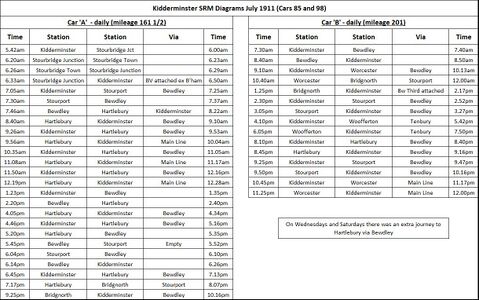 July 1911 Railmotor Car diagrams

Not long after the first Railmotors were introduced, the GWR had a surplus of small tank locomotives that had further service life in them. It was much cheaper to adapt these for auto working than produce a new power unit for an SRM which would cost over £1,100. Auto engines were adapted by Churchward from Armstrong's '517' class of 0-4-2T from 1905 although, even by 1911, 59 SRM diagrams were operating with around 15 auto-train services. The latter were proving themselves on busier services as up to 4 auto-fitted carriages could be attached with two each side of the locomotive. The running speeds were also higher as the SRMs were usually restricted to a top speed of 30mph.
However, it was not until a Superintendent's meeting in 1912, that a policy of conversion of old rail motor cars into trailers was adopted and not until April 1920 that all the earlier match-boarded cars were converted. The power unit was removed, the front section rebuilt and the power bogie replaced. The driving compartment at the trailing end was retained as a driving compartment for the new auto-trailer. The last SRMs were finally withdrawn week ending 19th October 1935 with the shed at Stourbridge being among the last operators. Not all cars were converted, five of the last batch being replaced by three Diesel Railcars. Car 93 (Diagram R of February 1908) was converted to trailer No 212 (Diagram A26) in May 1935. This trailer was condemned in May 1956 but survived as a Work Study Coach until brought to Didcot Railway Centre in 1970. With the aid of a major Heritage Lottery Fund grant it was returned to its SRM guise as No 93 in 2011. It now awaits overhaul before it can run again but could be used to re-create the 'Bewdley Banjo' experience in the future, at least between Kidderminster and Bewdley.
-
 Railmotor 93 and trailer car 92 (2013)

See also[edit | edit source]
References[edit | edit source]
Article prepared by Chris Haynes, mainly using sources:
- Great Western Steam Rail Motors, John Lewis, Wild Swan Publications
- Incident records from National Archives